Quotessence
Home / Quotes / Quote by Carl Sagan

Quote by Carl Sagan

Work

The Demon-Haunted World: Science as a Candle in the Dark

In this seminal work, the author delves into the principles of scientific inquiry, critical analysis, and evidence-based reasoning. The book serves as a guide to discerning fact from fiction, advocating for the importance of skepticism and rationality in understanding the natural world. more

Author
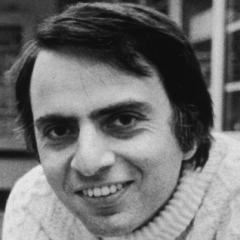
Carl Sagan
Carl Sagan

Carl Sagan was an American astronomer, cosmologist, author, and science communicator, born on November 9, 1934, in Brooklyn, New York. He is renowned for his profound research into the cosmos and his dedication to popularizing science. Sagan proposed numerous theories about the origin of the universe and life, and he made complex scientific knowledge accessible to the public with his unique perspective and clear, engaging writing style. more

You May Also Like

“Rev. David Wilkerson Warned that Former Witches Have Infiltrated Many Christian Churches: David Wilkerson exposed the current efforts of false teachers to infiltrate Christianity. Rev. Wilkerson was the pastor at Times Square Church in New York City, where he founded Teen Challenge, an addiction recovery program. He wrote, The Cross and the Switchblade, and he served as an evangelist for over 50 years (1). Throughout his ministry, Rev. Wilkerson preached against apostasy, including dominionism and the teaching that there is no literal return of Jesus (2). Shortly before his death, he stated that several former witches warned him that occultists were infiltrating the Church. They said witches are penetrating congregations and masquerading as super-spiritual Christians (3). Today, it is difficult to find a Christian Church that has not been transformed by this occult revival. References: 1. Wilkerson, David. The Cross and the Switchblade. Jove Publications. 1962. 2. Wilkerson, David, Rev. “Witchcraft in the Church.” Believers Web.org, 3. IBID.”

“There is a growing sentiment in America today that animals, too, have rights and that we collectively should afford them, at the very least, more respect and consideration as the sentient, autonomous beings they clearly are. Of course, this flies in the face of Western civilization's stated assumption of man's dominion over the beasts. The way we resolve this conflict in our culture, or fail to, has much to do with who we are, who we will become, and the legacy we leave for generations to come.”

“I didn’t confront the Dominionists directly, instead choosing to minister to the sick and hungry New Orleanians who arrived in DeQuincy in Katrina’s wake. But inside, I fumed at the Dominionist faction at Grace. Katrina was not about God’s judgment; it was about a storm that started as a low-pressure zone that slowly, dangerously grew into a tropical wave of low pressure. Katrina had a natural cause, not a supernatural cause. What flooded New Orleans and sent its citizenry into exile was not, as the Dominionists at Grace argued, God running spiritually corrupt, lost souls out of town but rather a catastrophically flawed levee system constructed by human hands. Besides, I believed that what we did to help those affected by the storm—not why the storm or its destruction happened—was what mattered. My Katrina-era messages were just blandly positive—I preached that the storm was a moment to prove to God just how loving we could be to one another—but the Dominionists at Grace were furious nonetheless. “Are you really saying,” they chided me after Sunday services, “that it doesn’t matter how people in New Orleans live? That they can be saved if they’re alcoholics?” I was unflinching in my answer. “Yes, “ I replied sternly, “that’s exactly what I’m saying.” The Dominionists simply shook their heads in disgust at my apostasy.”

“If miracles are to be common, everyday occurances, normal and not extraordinary, they cease to attract attention, and lose their very reason of existence. What is normal is according to law. If miracles are the law of the Christian life they cease to serve their chief end. The contention of the faith-healers overlooks numerous important Biblical facts. Primarily the fact that the miraculous gifts in the New Testament were the credentials of the apostles, and were confirmed to those to whom the apostles had conveyed them--whence a presumption arises against their continuance after the apostolic age. ... Paul did not share the views of our modern faith-healers.”

“He was a prince of the Ming dynasty. His family was very rich and very powerful. His father and grandfather were painters and famous calligraphers, and little Zhu Da had inherited their gift. So just imagine, one day, when he wasn't even eight years old yet, he drew a flower, a simple lotus flower floating on a pond. His drawing was beautiful that his mother decided to hang it in their salon. She claimed that thanks to the drawing you could feel a fresh little breeze in the huge room and you could even smell the flower's perfume when you walked by the drawing. Can you imagine? Even the perfume! And his mother was surely not an easy person to please... With both a husband and a father who were artists, she must have seen a few things by then...”