Quotessence
Home / Quotes / Quote by Bayard Taylor

Quote by Bayard Taylor

Author

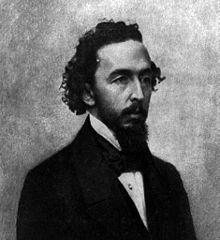
Bayard Taylor
Bayard Taylor

Bayard Taylor was an American poet, essayist, and translator. Born on January 11, 1825, in Nova Scotia, Canada, Taylor's early life was marked by his family's move to the United States. He is known for his romantic poetry and translations from various languages, including Latin, Greek, and German. Taylor's work often reflected his deep appreciation for nature and his travels, which included extensive tours of Europe. He died on December 19, 1878. more

You May Also Like

“I never thought I'd find such peace in simple reading. The words were a kind of magic, taking me by the hand and sweeping me into lands unseen, times unremembered, thoughts unimagined. Through all my years in San Michon, all the blood and sweat and darkling roads I walked, I learned one of my greatest lessons sitting in that Library with those girls in the still of the night. A life without books is a life not lived.”

“I prefer novels,” she adds, “that bring me immediately into a world where everything is precise, concrete, specific. I feel a special satisfaction in knowing what things are made in that certain fashion and not otherwise, even the most common place things that in real life seem indifferent to me.” “The book I would like to read now is a novel in which you sense the story arriving like still-vague thunder, the historical story along with the individual story, a novel that gives the sense of living through an upheaval that still has no name, has not yet taken shape…” “The novels I prefer,” she says, “are those that make you feel uneasy from the very first page.” “I like books,” she says, “where all the mysteries and anguish pass through a precise and a cold mind, without shadows, like the mind of a chess player.” “The novels that attract me most,” Ludmilla said, “are those that create an illusion of transparency around a knot of human relationships as obscure, cruel and perverse as possible.” “The quality of perennial dissatisfaction seems to me characteristic of Ludmilla: it seems to me that her preferences change overnight and today reflect only her restless.” “Do you mean to deny you have a sister?” “I have a sister, but I don’t see what that has to do with anything.” “A sister who loves novels with characters whose psychology is upsetting and complicated?” “My sister always says she loves novels where you feel an elemental strength, primordial, telluric. That’s exactly what she says: telluric.” “The book I’m looking for,” says the blurred figure who holds out a volume similar to yours, “is the one that gives the sense of the world after the end of the world, the sense that the world is the end of everything that there is the world, that the only thing there is in the world is the end of the world.”

“For this woman,” Arkadian Porphyrich continues, seeing how intently you are drinking in his words, “reading means stripping herself of every forgone conclusion, to be ready to catch a voice that comes from an unknown source, from somewhere beyond the book, beyond the author, beyond the conventions of writing: from the unsaid, from what the world has not yet said of itself and does not yet have the words to say.”

“Every new book I read comes to be a part of that overall and unitary book that is the sum of my readings. This does not come about without effort: to compose that general book, each individual book must be transformed, entered into a relationship with the books I have read previously, become their corollary or development or confutation or gloss or reference text. For years I have been coming to this library, and I explore it volume by volume, shelf by shelf, but I could demonstrate to you that I have done nothing but continue the reading of a single book.”