Quotessence
Home / Quotes / Quote by Italo Calvino

Quote by Italo Calvino

“For this woman,” Arkadian Porphyrich continues, seeing how intently you are drinking in his words, “reading means stripping herself of every forgone conclusion, to be ready to catch a voice that comes from an unknown source, from somewhere beyond the book, beyond the author, beyond the conventions of writing: from the unsaid, from what the world has not yet said of itself and does not yet have the words to say.”

Quote by Italo Calvino

Work

If on a winter's night a traveler

This novel is a postmodern work that combines elements of fantasy, science fiction, and metafiction. It follows the story of a reader who becomes immersed in a series of tales, each with its own unique style and ending. The narrative structure is non-linear and often self-referential, challenging the reader's perception of reality and the nature of storytelling. more

Author
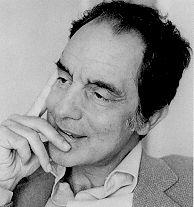
Italo Calvino
Italo Calvino

Italian writer and journalist, known for his unique narrative style and rich imagination. Calvino is considered one of the greatest writers of the 20th century, whose works have had a profound impact on literature both in Italy and around the world. more

You May Also Like

“Every new book I read comes to be a part of that overall and unitary book that is the sum of my readings. This does not come about without effort: to compose that general book, each individual book must be transformed, entered into a relationship with the books I have read previously, become their corollary or development or confutation or gloss or reference text. For years I have been coming to this library, and I explore it volume by volume, shelf by shelf, but I could demonstrate to you that I have done nothing but continue the reading of a single book.”

“Together they read plays and poems by William Shakespeare and Thomas Hobbes's Leviathan, and Bianca translated some of Ovid's poetry for her as well as parts of Homer's great works. They relished the poems of Andrew Marvell, John Dryden and John Milton. They read excerpts from the King James Bible, as well as passages from books of history, gardening, medicine and more. The closet wasn't much, but it was Rosamund's, especially now it bore no resemblance to its former owner. It was her cave in which, like Ali Baba, she kept her trove of treasured ideas and growing knowledge, but could open and close it at will with the key hanging around her neck. It was in this room that Rosamund finally started to feel a sense of belonging.”

“She had devoted time to improving her reading and was now more than proficient. The shelf she'd first cleared with Bianca overflowed with tales of King Arthur and his knights, Ovid's poetry, plays by Sophocles, Aristotle and Aeschylus, Apuleius, names she loved repeating in her mind because the mere sound of them conjured the drama, pageantry, passion, transformations and suffering of their heroes and heroines. One of her favorite writers was Geoffrey Chaucer-- his poems of pilgrims exchanging stories as they traveled to a shrine in Canterbury were both heart aching and often sidesplittingly funny. Admittedly, one of the reasons she loved Chaucer was because she could read him for herself. It was the same reason she picked up Shakespeare over and over, and the works of Margaret Cavendish, the Duchess of Newcastle upon Tyne. They all wrote in English. Regarded as quite the eccentric, the duchess was a woman of learning who, like Rosamund, was self-taught. Her autobiography, A True Relation of my Birth, Breeding and Life, a gift from Mr. Henderson, gave Rosamund a model to emulate. Here was a woman who dared to consider not only philosophy, science, astronomy and romance, but to write about her reflections and discoveries in insightful ways. Defying her critics, she determined that women were men's intellectual equal, possessed of as quick a wit and as many subtleties if only given the means to express themselves-- in other words, access to education.”

“આપણે ગમ્મે તેટલા સાચા હોઈએ, કેટલીક લડાઈઓ જીતવી નિરર્થક હોય છે. જેમને અજ્ઞાનતામાં અજવાળું દેખાતું હોય, એમની પાસે જ્ઞાનની વાતો કરવી મૂર્ખામી છે. જેઓ પોતાની અજ્ઞાનતાને વફાદાર હોય, એમની સામે જ્ઞાનનું પ્રદર્શન ક્યારેય ન કરવું.”

“Let’s have a look at the books. The first thing noticed, at least on looking at those you have most prominent, is that the function of books for you is immediate reading; they are not instruments of study or reference or components of a library arranged according to some order. Perhaps on occasion you have tried to give a semblance of order to your shelves, but every attempt at classification was rapidly foiled by heterogeneous acquisitions. The chief reason for the juxtaposition of volumes, besides the dimensions of the tallest or the shortest, remains chronological, as they arrived here, one after the other, anyway you can always put your hand on any one. …and perhaps you don’t find yourself hunting for a book you have already read.”