Quotessence
Home / Quotes / Quote by Italo Calvino

Quote by Italo Calvino

“Let’s have a look at the books. The first thing noticed, at least on looking at those you have most prominent, is that the function of books for you is immediate reading; they are not instruments of study or reference or components of a library arranged according to some order. Perhaps on occasion you have tried to give a semblance of order to your shelves, but every attempt at classification was rapidly foiled by heterogeneous acquisitions. The chief reason for the juxtaposition of volumes, besides the dimensions of the tallest or the shortest, remains chronological, as they arrived here, one after the other, anyway you can always put your hand on any one. …and perhaps you don’t find yourself hunting for a book you have already read.”

Quote by Italo Calvino

Work

If on a winter's night a traveler

This novel is a postmodern work that combines elements of fantasy, science fiction, and metafiction. It follows the story of a reader who becomes immersed in a series of tales, each with its own unique style and ending. The narrative structure is non-linear and often self-referential, challenging the reader's perception of reality and the nature of storytelling. more

Author
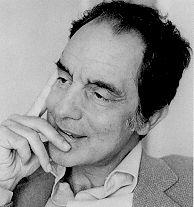
Italo Calvino
Italo Calvino

Italian writer and journalist, known for his unique narrative style and rich imagination. Calvino is considered one of the greatest writers of the 20th century, whose works have had a profound impact on literature both in Italy and around the world. more

You May Also Like

“You are at your desk, you have set the book among your business papers as if by chance; at a certain moment you shift the file and you find the book before your eyes, you open it absently, you rest your elbows on the desk, you rest your temples against your hands, curled into fists, you seem to be concentrating on an examination of the papers and instead you are exploring the first pages of the novel. Gradually you settle back in the chair, you raise the book to the level of your nose, you tilt your chair, poised on its rear legs, you pull out a side drawer of the desk to prop your feet on it: the position of the feet during reading is of maximum importance, you stretch your legs out on the top of the desk, on the files to be expedited. But doesn’t this seem to show a lack of respect? Of respect that is, not for your job (nobody claims to pass judgment on your professional capacities: we assume that your duties are a normal element n the system of unproductive activities that occupies such a large part of the national and international economy), but for the book. Worse still if you belong—willingly or unwillingly—to the number of those for whom working means really working, performing, whether deliberately or without premeditation, something necessary or at least not useless for others as well as for oneself; then the book you have brought with you to your place of employment like a kind of amulet or talisman exposes you to intermittent temptations, a few seconds at a time subtracted from the principal object of your attention, whether it is the perforations of electronic cards, the burners of a kitchen stove, the controls of a bulldozer, a patient stretched out on the operating table with his guts exposed. In other words, it’s better for you to restrain your impatience and wait to open the book at home.”

“So here you are now, ready to attack the first lines of the first page. You prepare to recognize the unmistakable tone of the author. No. You don't recognize it at all. But now that you think about it, who ever said this author had an unmistakable tone? On the contrary, he is known as an author who changes greatly from one book to the next. And in these very changes you recognize him as himself. Here, however, he seems to have absolutely no connection with all the rest he has written, at least as far as you can recall. Are you disappointed? Let’s see. Perhaps at first you feel a bit lost, as when a person appears who, from the name, you identified with a certain face, and you try to make the features you are seeing tally with those you had in mind, and it won’t work. But you go on and you realize that the book is readable nevertheless, independently of what you expected of the author, it’s the book itself that arouses your curiosity, in fact, on sober reflection, you prefer it this way, confronting something and not quite knowing yet what it is.”

“Reading is a discontinuous and fragmentary operation. Or rather, the object of reading is punctiform and pulviscular material. In the spreading expanse of the writing, the reader’s attention isolates some minimal segments, juxtapositions of words, metaphors, syntactic nexuses, logical passages, lexical peculiarities that prove to possess an extremely concentrated density of meaning. They are like elemental particles making up the work’s nucleus, around which all the rest revolves or else like the void at the bottom of a vortex which sucks in and swallows currents. It is through these apertures that, in barely perceptible flashes, the truth the book may bear is revealed, its ultimate substance. Myth and mysteries consist of impalpable little granules like the pollen that sticks to a butterfly’s legs, only those who have realized this can expect revelations and illuminations. This is why my attention, in contrast to what you, sir, were saying, cannot be detached from the written lines even for an instant. I must not be distracted if I do not wish to miss some valuable clue. Every time I come upon one of these clumps of meaning I must go on digging around to see if the nugget extends into a vein. This is why my reading has no end. I read and reread, each time seeking the confirmation of a new discovery among the folds of the sentences.”

“I opened it the way we used to open Hafez, closing our eyes, asking our question and letting our finger rest somewhere at random. It opened to the page in the middle of "Burt Norton,' beginning with the lines "At the still point of the turning world. Neither flesh nor/fleshless./ Neither from not toward; at the still point,there the dance/is.”

“I have everything I want. The fame. The stardom. I’ve reached success others can only fantasize about. I see my name and face on beauty products. It’s a dream! The spotlight, I mean. I’m afraid this marriage is falling apart and hasn’t been working for years. I suspect all the women he’s been with. Too many to name. But if I bring it up, he gets mad and even denies it. And if I leave now…I could lose everything I’ve worked for. He made my fortune. He can take it away. For now, I will just pose and smile. But I hate to admit, something is still missing.”

“અન્યની દરેક નાની ભૂલને બ્રોડકાસ્ટ કરવી કે સુધારવી જરૂરી નથી હોતી. નાની નાની બાબતોની ફરિયાદ ન કરવી, એ પણ એક એપ્રિસિએશન છે. કોઈની કદર કરવા માટે દર વખતે પ્રશંસા કરવી જરૂરી નથી હોતી. એમની નાની અને માનવ સહજ ક્ષતિઓ ઈગ્નોર કરીને પણ આપણે તેમની કદર કરી શકીએ છીએ.”