Quotessence
Home / Quotes / Quote by Shunryu Suzuki

Quote by Shunryu Suzuki

Work

Zen Mind, Beginner's Mind: Informal Talks on Zen Meditation and Practice

This book presents a series of informal talks by Shunryu Suzuki, a prominent Zen Buddhist teacher, focusing on the practice of Zen meditation and its principles. Suzuki's teachings emphasize the importance of mindfulness and the beginner's mind, encouraging readers to approach their practice with openness and simplicity. more

Author
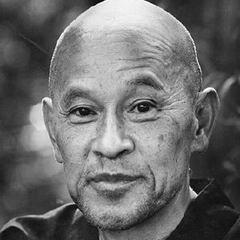
Shunryu Suzuki
Shunryu Suzuki

Shunryu Suzuki, born on May 18, 1904, was a renowned Zen master from Japan. He played a significant role in spreading Zen culture in the Western world. more

You May Also Like

“Who are you without your labels and attachments to the issues you are passionate about? Remove the emotions, remove the beliefs and associations, and simply focus on the rational and practical applications that promote peaceful progression.”

“The more I can accept the fact that change is moving all the time, and that the change I am experiencing right now is just the change of this moment and that this moment will change into the next and the next, the less need I will have to clutch in fear.”

“The story of the Fall tells us in mythical language that "original sin" is not simply a stigma arbitrarily making good pleasures seem guilty, but a basic inauthenticity, a kind of predisposition to bad faith in our understanding of ourselves and of the world. It implies a determined willfulness in trying to make things be other than they are in order that we may be able to make them subserve, at any moment, to our individual desire for pleasure or for power. But since things do not obey our arbitrary impulsions, and since we cannot make the world correspond to and confirm the image of it dictated by our needs and illusions, our willfulness is inseparable from error and from suffering. Hence, Buddhism says, deluded life itself is in a state of Dukkha, and every movement of desire tends to bear ultimate fruit in pain rather than lasting joy, in hate rather than love, in destruction rather than creation. (Let us note in passing that when technological skill seems in fact to give man almost absolute power in manipulating the world, this fact is no way reverses his original condition of brokenness and error but only makes it all the more obvious. We who live in the age of the H-bomb and the extermination camp have reason to reflect on this, though such reflection is a bit unpopular.)”

“The true Christian was intended by Christ to prove all things by the Word of God: all churches, all ministers, all teaching, all preaching, all doctrines, all sermons, all writings, all opinions, all practices. These are his marching orders. Prove all by the Word of God; measure all by the measure of the Bible; compare all with the standard of the Bible; weigh all in the balances of the Bible; examine all by the light of the Bible; test all in the crucible of the Bible. That which cannot abide the fire of the Bible, reject, refuse, repudiate, and cast away. This is the flag which he nailed to the mast. May it never be lowered!”

“The standard-brand religions [...] are — as now practiced — like exhausted mines: very hard to dig. With some exceptions not too easily found, their ideas about man and the world, their imagery, their rites, and their notions of the good life don't seem to fit in with the universe as we now know it, or with a human world that is changing so rapidly that much of what one learns in school is already obsolete on graduation day.”