Quotessence
Home / Quotes / Quote by Stephen Hawking

Quote by Stephen Hawking

“During our glorious year of 1974–5, while I was dithering over gravitational waves, and Stephen was leading our merged group in black hole research, Stephen himself had an insight even more radical than his discovery of Hawking radiation. He gave a compelling, almost airtight proof that, when a black hole forms and then subsequently evaporates away completely by emitting radiation, the information that went into the black hole cannot come back out. Information is inevitably lost. This is radical because the laws of quantum physics insist unequivocally that information can never get totally lost. So, if Stephen was right, black holes violate a most fundamental quantum mechanical law. How could this be? The black hole’s evaporation is governed by the combined laws of quantum mechanics and general relativity—the ill-understood laws of quantum gravity; and so, Stephen reasoned, the fiery marriage of relativity and quantum physics must lead to information destruction. The great majority of theoretical physicists find this conclusion abhorrent. They are highly sceptical. And so, for forty-four years they have struggled with this so-called information-loss paradox. It is a struggle well worth the effort and anguish that have gone into it, since this paradox is a powerful key for understanding the quantum gravity laws. Stephen himself, in 2003, found a way that information might escape during the hole’s evaporation, but that did not quell theorists’ struggles. Stephen did not prove that the information escapes, so the struggle continues. In my eulogy for Stephen, at the interment of his ashes at Westminster Abbey, I memorialised that struggle with these words: “Newton gave us answers. Hawking gave us questions. And Hawking’s questions themselves keep on giving, generating breakthroughs decades later. When ultimately we master the quantum gravity laws, and comprehend fully the birth of our universe, it may largely be by standing on the shoulders of Hawking.”

Quote by Stephen Hawking

Work

Brief Answers to the Big Questions

Browse quotes and source details for this work. more

Author
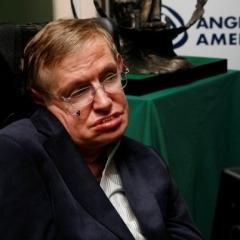
Stephen Hawking
Stephen Hawking

Stephen Hawking was a renowned British theoretical physicist known for his contributions to the fields of black hole theory and cosmology. Born on January 8, 1942, he overcame the challenges of ALS to become a global icon of science and perseverance. more

You May Also Like

“This was a golden age, in which we solved most of the major problems in black hole theory even before there was any observational evidence for black holes. In fact, we were so successful with the classical general theory of relativity that I was at a bit of a loose end in 1973 after the publication with George Ellis of our book The Large Scale Structure of Space–Time. My work with Penrose had shown that general relativity broke down at singularities, so the obvious next step would be to combine general relativity—the theory of the very large—with quantum theory—the theory of the very small. In particular, I wondered, can one have atoms in which the nucleus is a tiny primordial black hole, formed in the early universe? My investigations revealed a deep and previously unsuspected relationship between gravity and thermodynamics, the science of heat, and resolved a paradox that had been argued over for thirty years without much progress: how could the radiation left over from a shrinking black hole carry all of the information about what made the black hole? I discovered that information is not lost, but it is not returned in a useful way—like burning an encyclopedia but retaining the smoke and ashes. To answer this, I studied how quantum fields or particles would scatter off a black hole. I was expecting that part of an incident wave would be absorbed, and the remainder scattered. But to my great surprise I found there seemed to be emission from the black hole itself. At first, I thought this must be a mistake in my calculation. But what persuaded me that it was real was that the emission was exactly what was required to identify the area of the horizon with the entropy of a black hole. This entropy, a measure of the disorder of a system, is summed up in this simple formula which expresses the entropy in terms of the area of the horizon, and the three fundamental constants of nature, c, the speed of light, G, Newton’s constant of gravitation, and ħ, Planck’s constant. The emission of this thermal radiation from the black hole is now called Hawking radiation and I’m proud to have discovered it.”

“Despite the complexity and variety of the universe, it turns out that to make one you need just three ingredients. Let’s imagine that we could list them in some kind of cosmic cookbook. So what are the three ingredients we need to cook up a universe? The first is matter—stuff that has mass. Matter is all around us, in the ground beneath our feet and out in space. Dust, rock, ice, liquids. Vast clouds of gas, massive spirals of stars, each containing billions of suns, stretching away for incredible distances. The second thing you need is energy. Even if you’ve never thought about it, we all know what energy is. Something we encounter every day. Look up at the Sun and you can feel it on your face: energy produced by a star ninety-three million miles away. Energy permeates the universe, driving the processes that keep it a dynamic, endlessly changing place. So we have matter and we have energy. The third thing we need to build a universe is space. Lots of space. You can call the universe many things—awesome, beautiful, violent—but one thing you can’t call it is cramped. Wherever we look we see space, more space and even more space. Stretching in all directions. It’s enough to make your head spin. So where could all this matter, energy and space come from? We had no idea until the twentieth century. The answer came from the insights of one man, probably the most remarkable scientist who has ever lived. His name was Albert Einstein. Sadly I never got to meet him, since I was only thirteen when he died. Einstein realised something quite extraordinary: that two of the main ingredients needed to make a universe—mass and energy—are basically the same thing, two sides of the same coin if you like. His famous equation E = mc2 simply means that mass can be thought of as a kind of energy, and vice versa. So instead of three ingredients, we can now say that the universe has just two: energy and space. So where did all this energy and space come from? The answer was found after decades of work by scientists: space and energy were spontaneously invented in an event we now call the Big Bang.”

“The idea that space and time may form a closed surface without boundary also has profound implications for the role of God in the affairs of the universe. With the success of scientific theories in describing events, most people have come to believe that God allows the universe to evolve according to a set of laws and does not intervene in the universe to break these laws. However, the laws do not tell us what the universe should have looked like when it started - it would still be up to God to wind up the clockwork and choose how to start it off. So long as the universe had a beginning, we could suppose it had a creator. But if the universe is really completely self-contained, having no boundary or edge, it would have neither beginning nor end: it would simply be. What place then, for a creator?”

“The cosmic perspective flows from fundamental knowledge. But it’s more than about what you know. It’s also about having the wisdom and insight to apply that knowledge to assessing our place in the universe. And its attributes are clear: The cosmic perspective comes from the frontiers of science, yet it is not solely the provenance of the scientist. It belongs to everyone. The cosmic perspective is humble. The cosmic perspective is spiritual—even redemptive—but not religious. The cosmic perspective enables us to grasp, in the same thought, the large and the small. The cosmic perspective opens our minds to extraordinary ideas but does not leave them so open that our brains spill out, making us susceptible to believing anything we’re told. The cosmic perspective opens our eyes to the universe, not as a benevolent cradle designed to nurture life but as a cold, lonely, hazardous place, forcing us to reassess the value of all humans to one another. The cosmic perspective shows Earth to be a mote. But it’s a precious mote and, for the moment, it’s the only home we have. The cosmic perspective finds beauty in the images of planets, moons, stars, and nebulae, but also celebrates the laws of physics that shape them. The cosmic perspective enables us to see beyond our circumstances, allowing us to transcend the primal search for food, shelter, and a mate. The cosmic perspective reminds us that in space, where there is no air, a flag will not wave—an indication that perhaps flag-waving and space exploration do not mix. The cosmic perspective not only embraces our genetic kinship with all life on Earth but also values our chemical kinship with any yet-to-be discovered life in the universe, as well as our atomic kinship with the universe itself.”

“On September 14, 2015, the LIGO gravitational-wave detectors (built by a 1,000-person project that Rai and I and Ronald Drever co-founded, and Barry Barish organised, assembled and led) registered their first gravitational waves. By comparing the wave patterns with predictions from computer simulations, our team concluded that the waves were produced when two heavy black holes, 1.3 billion light years from Earth, collided. This was the beginning of gravitational-wave astronomy. Our team had achieved, for gravitational waves, what Galileo achieved for electromagnetic waves. I am confident that, over the coming several decades, the next generation of gravitational-wave astronomers will use these waves not only to test Stephen’s laws of black hole physics, but also to detect and monitor gravitational waves from the singular birth of our universe, and thereby test Stephen’s and others’ ideas about how our universe came to be.”

“People have always wanted answers to the big questions. Where did we come from? How did the universe begin? What is the meaning and design behind it all? Is there anyone out there? The creation accounts of the past now seem less relevant and credible. They have been replaced by a variety of what can only be called superstitions, ranging from New Age to Star Trek. But real science can be far stranger than science fiction, and much more satisfying. I am a scientist. And a scientist with a deep fascination with physics, cosmology, the universe and the future of humanity. I was brought up by my parents to have an unwavering curiosity and, like my father, to research and try to answer the many questions that science asks us. I have spent my life travelling across the universe, inside my mind. Through theoretical physics, I have sought to answer some of the great questions. At one point, I thought I would see the end of physics as we know it, but now I think the wonder of discovery will continue long after I am gone. We are close to some of these answers, but we are not there yet.”

“The big question in cosmology in the early 1960s was did the universe have a beginning? Many scientists were instinctively opposed to the idea, because they felt that a point of creation would be a place where science broke down. One would have to appeal to religion and the hand of God to determine how the universe would start off. This was clearly a fundamental question, and it was just what I needed to complete my PhD thesis. Roger Penrose had shown that once a dying star had contracted to a certain radius, there would inevitably be a singularity, that is a point where space and time came to an end. Surely, I thought, we already knew that nothing could prevent a massive cold star from collapsing under its own gravity until it reached a singularity of infinite density. I realised that similar arguments could be applied to the expansion of the universe. In this case, I could prove there were singularities where space–time had a beginning. A eureka moment came in 1970, a few days after the birth of my daughter, Lucy. While getting into bed one evening, which my disability made a slow process, I realised that I could apply to black holes the casual structure theory I had developed for singularity theorems. If general relativity is correct and the energy density is positive, the surface area of the event horizon—the boundary of a black hole—has the property that it always increases when additional matter or radiation falls into it. Moreover, if two black holes collide and merge to form a single black hole, the area of the event horizon around the resulting black hole is greater than the sum of the areas of the event horizons around the original black holes.”

“I have led an extraordinary life on this planet, while at the same time travelling across the universe by using my mind and the laws of physics. I have been to the furthest reaches of our galaxy, travelled into a black hole and gone back to the beginning of time. On Earth, I have experienced highs and lows, turbulence and peace, success and suffering. I have been rich and poor, I have been able-bodied and disabled. I have been praised and criticised, but never ignored. I have been enormously privileged, through my work, in being able to contribute to our understanding of the universe. But it would be an empty universe indeed if it were not for the people I love, and who love me. Without them, the wonder of it all would be lost on me. And at the end of all this, the fact that we humans, who are ourselves mere collections of fundamental particles of nature, have been able to come to an understanding of the laws governing us, and our universe, is a great triumph. I want to share my excitement about these big questions and my enthusiasm about this quest.”

“At the moment of the Big Bang, an entire universe came into existence, and with it space. It all inflated, just like a balloon being blown up. So where did all this energy and space come from? How does an entire universe full of energy, the awesome vastness of space and everything in it, simply appear out of nothing? For some, this is where God comes back into the picture. It was God who created the energy and space. The Big Bang was the moment of creation. But science tells a different story. At the risk of getting myself into trouble, I think we can understand much more the natural phenomena that terrified the Vikings. We can even go beyond the beautiful symmetry of energy and matter discovered by Einstein. We can use the laws of nature to address the very origins of the universe, and discover if the existence of God is the only way to explain it.”