Quotessence
Home / Quotes / Quote by Iris Murdoch

Quote by Iris Murdoch

“Of course it seems ridiculous now, it seems stupid, to have suffered so much because of something so accidental and sort of frail which didn't have to happen and so very nearly didn't, and of course guilt is irrational, that was partly what made me think it would all vanish. But the irrationality is of the essence, it goes all the way through, it isn't any sort of fulcrum or escape route, it's the lot - I was destined to suffer stupidly, my mother suffered stupidly, my father suffered stupidly (...), it's what we were made for.”

Quote by Iris Murdoch

Work

A Word Child

This book delves into the unique experiences of a child whose profound connection to language shapes their world and perception. more

Author

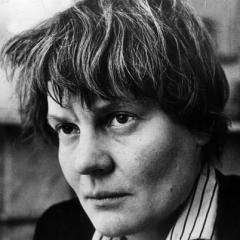
Iris Murdoch
Iris Murdoch

Iris Murdoch was an Irish-Canadian philosopher and author, born on July 15, 1919, in Dublin, Ireland, and passed away on February 8, 1999. She is celebrated for her philosophical novels that intertwine moral and ethical dilemmas with complex narratives. Murdoch's work has left a lasting impact on the literary world, particularly in the latter half of the 20th century. more

You May Also Like

“For there to be harmony and peace, everything must be balanced. And for there to be balance, there must be equality. And where there is equality, there will be justice. And where justice is honored and preserved, there will always be truth. Eliminate the concept of division by class, skills, race, income, and nationality. We are all equals with a common pulse to survive. Every human requires food and water. Every human has a dream and desire to be happy. Every human responds to love, suffering and pain. Every human bleeds the same color and occupies the same world. Let us recognize that we are all part of each other. We are all human. We are all one.”

“In our day non-Christian mysticism attracts many who despair at the banality and emptiness of the contemporary scene. They are ignorant of the true essence of Christianity. Christianity entails suffering; but through suffering we penetrate the mysteries of Being. Suffering makes it possible to comprehend one’s own humanity and freedom. In times of distress the Christian remembers that ‘the whole creation groaneth and travaileth in pain’ (Rom. 8.22) and his spirit is conscious of the same life flowing through all of us. To extend the range of our consciousness makes us kin with millions of fellow-beings scattered over the face of the earth. An enhanced recognition of human suffering begets intense prayer which transfers all things into the realm of the spirit.”

“Part of every misery is, so to speak, the misery’s shadow or reflection: the fact that you don’t merely suffer but have to keep on thinking about the fact that you suffer. I not only live each endless day in grief, but live each day thinking about living each day in grief. Do these notes merely aggravate that side of it? Merely confirm the monotonous, tread-mill march of the mind round one subject? But what am I to do? I must have some drug, and reading isn’t a strong enough drug now. By writing it all down (all?—no: one thought in a hundred) I believe I get a little outside it.”

“Remember also that whatever is misery to you to read, is still greater misery to me to set down. To you the Unseen Powers have been very good. They have permitted you to see the strange and tragic shapes of Life as one sees shadows in a crystal. The head of Medusa that turns living men to stone, you have been allowed to look at in a mirror merely. You yourself have walked free among the flowers. From me the beautiful world of colour and motion has been taken away.”