Quotessence
Home / Quotes / Quote by Sangharakshita

Quote by Sangharakshita

“Once you have entered the Stream, yon are irreversibly bound for Enlightenment, one could say; you have sufficient spiritual momentum to take you all the way. You may still have a long way to go, but you are now safe from any danger of losing what you have gained. It is therefore said of the Buddha’s ‘victory’, his attainment of Enlightenment, that it is irreversible. It cannot be undone. There is no outside power that can make a Buddha no longer a Buddha. This applies not only to the Buddha, but also to the Arhant, the Once-Returner, and the Stream Entrant – and of course the irreversible Bodhisattva. But until we have passed through that gate of irreversibility we are in a precarious position. This is why we need to make a constant effort in our spiritual life and also make sure that we are living and working in conditions that support our spiritual efforts. Until we have reached that point of no return, we need the most positive situation, the most helpful environment, we can possibly get.”

Quote by Sangharakshita

Work

The Bodhisattva Ideal : Wisdom and Compassion in Buddhism

Browse quotes and source details for this work. more

Author
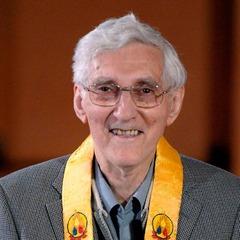
Sangharakshita
Sangharakshita

Sangharakshita, born John William Robert Mawson, is a British writer and Buddhist leader, considered one of the pioneers of the Buddhist revival in the West. Born in 1925, he has been a significant figure in the Western Buddhist community. more

You May Also Like

“Many people become aware of the effect of positive conditions when they go on retreat for the first time. The degree to which one can change in the course of just a few days is remarkable. Just leaving the city and staying in the country, being undisturbed by the pull of trivial distractions, and doing a bit more meditation and Dharma study than you usually have time for, can transform you into quite a different person – much happier, much more positive. So it isn’t enough to try to change one’s mental state through meditation; one needs the co-operation of one’s environment. Without this it is very difficult, even impossible, to develop spiritually up to the point of irreversibility.”

“The Enlightened mind sees truly – without distinction – anything that comes before it; it understands the true nature of everything, just as a mirror faithfully reflects all objects. If one looks into the depths of the Enlightened mind one sees everything. It is like the experience of Sudhana as described in the Gandavyuha-Sutra. Sudhana is a pilgrim wandering in search of truth, and at the crucial point of the sutra he reaches a magnificent tower in south India. Entering the tower he sees the whole cosmos mirrored, stretching out to infinity – but all contained within this magical tower. In fact, the tower is a symbol of the bodhicitta, or of the Enlightened mind itself.”

“The mind and the body are two distinct phenomena. Mind is defined as that which is clear and perceives objects. Like reflections appearing in a mirror, objects appear clearly to the mind, and the mind is able to recognize them. Whereas the body is substantial, the mind is formless, without color or shape. Whereas the body disintegrates after death, the mind continues from life to life. It is not uncommon to hear of people in both the East and the West who are able to remember past lives and to see future lives, not only their own but also those of others. Some are born with this capacity; others develop it through meditation. Some people can remember lives hundreds or thousands of years ago. When Lama Yeshe, who guided me for many years, visited the pyramids in Egypt, he was able to remember that he had lived there in a past life. The point is that even though many people do not believe in past and future lives, no one has actually proved that past and future lives do not exist. On the other hand, many people have realized that past lives exist because they remember them very clearly, just as we remember what we did yesterday. They realize the truth of reincarnation because they have the capacity of mind to see past and future lives.”

“Healing our mind is crucial, because otherwise our problems, which are beginningless, become endless. We may use medicine or some other external means to heal a particular disease, but the disease will return unless we heal our mind. If we do nothing to heal our mind, there is always the danger that we will again create the cause of the disease, that we will repeat the actions that caused us to become physically unhealthy. We will then experience the same illness in future lives, or even in this life. Curing disease through external means is not the best solution because the cause of disease is not external. Bacteria, viruses, spirits, and so forth may act as external conditions for disease, but disease itself has no external cause. In the West, however, the external conditions for a particular disease are usually regarded as its cause. The cause of disease is not external; it is in the mind – or we could say, it is the mind. Disease is caused by our self-cherishing, ignorance, anger, attachment, and other delusions and by the negative actions motivated by these negative thoughts. Our negative thoughts and actions leave imprints on our mind, which then manifest as disease or other problems. The imprints also make it possible for disturbing thoughts and negative actions to arise again. A physical sign necessarily has a physical cause, but the physical cause arises because of the inner cause, the imprints left on the mind by negative thoughts and actions. To fully understand disease, we have to understand the inner cause, which is the actual cause of disease and which also creates the physical conditions for disease. As long as we ignore its inner cause, we have no real cure for disease. We must study its development and recognize that its cause is in the mind. Once we recognize this, we will automatically understand that the healing of disease also has to come from the mind. (p. 4-5)”

“In Liberation in the Palm of Your Hand, Pabongka Rinpoche explains how the great Atisha would purify any negativity, no matter how small, immediately. Even in public or when riding his horse, as soon as he noticed a breach of his ethics, he would stop what he was doing, drop to one knee and then and there, purify it with the four opponent powers—the powers of dependence, regret, remedy and restraint. Of course, compared to us, Atisha may not have had that much to purify. Still, he would say, “I never break my pratimoksha vows; I rarely break my bodhisattva vows; but my tantric vows—I transgress those like falling rain.” Atisha practiced purification in this way because of his deep realization of the psycho-mechanics of negative karma, especially its four fundamentals: negative karma is certain to bring suffering; it multiplies exponentially; if eradicated, it cannot bring its suffering result; and once created, it never simply disappears. Through the study and practice of Dharma, we should try to attain Atisha’s level of understanding. In the meantime, we should try to practice as he did.”

“When Gandhi said that love is the force that can liberate, he meant we have to love our enemy. Even if our enemy is cruel, even if he is crushing us, sowing terror and injustice, we have to love him. This is the message of Jesus. But how can we love our enemy? There is only one way - to understand him. We have to understand why he is that way, how he has come to be like that, why he does not see things the way we do. Understanding a person brings us the power to love and accept him. And the moment we love and accept him, he ceases to be our enemy. To "love our enemy" is impossible, because the moment we love him, he is no longer our enemy.”

“Though we're conditioned to identify with the thoughts that pass through our awareness rather than with awareness itself, the awareness that is our true nature is infinitely flexible. It is capable of any and every sort of experience - even misconceptions about itself as limited, trapped, ugly, anxious, lonely, or afraid. When we begin to identify with that timeless, pristine awareness rather than with the thoughts, feelings, and sensations that pass through it, we've taken the first step toward facing the freedom of our true nature.”

“The significance of meditating on impermanence and death is not just to terrify yourself; there is no point in simply making yourself afraid of death. The purpose of meditating on impermanence and death is to remind you of the preciousness of the opportunities that exist for you in life as a human being. Reminding yourself that death is inevitable, its time unpredictable and when it happens only spiritual practice is of benefit gives you a sense of urgency and enables you to truly appreciate the value of your human existence and your potential to fulfill the highest of spiritual aspirations. If you can develop this profound appreciation, you will treat every single day as extremely precious.”