Quotessence
Home / Quotes / Quote by Rod Serling

Quote by Rod Serling

“As long as they talk about you, you're not really dead, as long as they speak your name, you continue. A legend doesn't die, just because the man dies.”

Quote by Rod Serling

Author
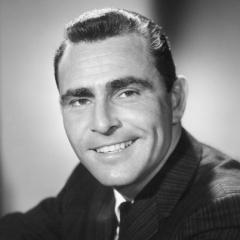
Rod Serling
Rod Serling

Rod Serling (December 25, 1924 – June 28, 1975) was an American screenwriter, producer, and television pioneer best known for creating the iconic anthology series The Twilight Zone. Born in Syracuse, New York, he served in the U.S. Army's 11th Airborne Division during World War II, an experience that deeply influenced his writing. After the war, he studied at Antioch College and began his career in television. Serling's work often explored social issues, human nature, and morality through science fiction and fantasy. He won six Emmy Awards and a Peabody Award. His legacy includes The Twilight Zone, Night Gallery, and numerous teleplays. He died of a heart attack in 1975, but his influence on television storytelling remains profound. more

You May Also Like

“When you deeply love someone from that space that is beyond attachment to certain projections or desires, when you love someone just deeply, totally, completely, without any games that the mind or emotions play, then that love remains eternal in the heavens forever, and that is what pulls you back to remembering that love.”

“In 2008, the national Coping with Cancer project published a study showing that terminally ill cancer patients who were put on a mechanical ventilator, given electrical defibrillation or chest compressions, or admitted, near death, to intensive care had a substantially worse quality of life in their last week than those who received no such interventions. And, six months after their death, their caregivers were three times as likely to suffer major depression. Spending one’s final days in an I.C.U. because of terminal illness is for most people a kind of failure. You lie on a ventilator, your every organ shutting down, your mind teetering on delirium and permanently beyond realizing that you will never leave this borrowed, fluorescent place. The end comes with no chance for you to have said goodbye or “It’s O.K.” or “I’m sorry” or “I love you.” People have concerns besides simply prolonging their lives. Surveys of patients with terminal illness find that their top priorities include, in addition to avoiding suffering, being with family, having the touch of others, being mentally aware, and not becoming a burden to others. Our system of technological medical care has utterly failed to meet these needs, and the cost of this failure is measured in far more than dollars. The hard question we face, then, is not how we can afford this system’s expense. It is how we can build a health-care system that will actually help dying patients achieve what’s most important to them at the end of their lives.”

“The Divine has created this moment in time. It is a very powerful moment, where there is only one way and that way is that you completely let go. Completely let go of what is known, what is safe, and move into the space of beauty.”

“A study led by the Harvard researcher Nicholas Christakis asked the doctors of almost five hundred terminally ill patients to estimate how long they thought their patient would survive, and then followed the patients. Sixty-three per cent of doctors overestimated survival time. Just seventeen per cent underestimated it. The average estimate was five hundred and thirty per cent too high. And, the better the doctors knew their patients, the more likely they were to err.”