Quotessence
Home / Quotes / Quote by Steven Weinberg

Quote by Steven Weinberg

“To calculate 'the' fine structure constant, 1/137, we would need a realistic model of just about everything, and this we do not have. In this talk I want to return to the old question of what it is that determines gauge couplings in general, and try to prepare the ground for a future realistic calculation.”

Quote by Steven Weinberg

Work

Author

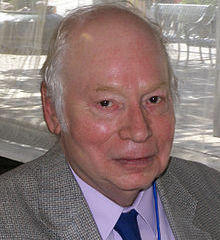
Steven Weinberg
Steven Weinberg

Steven Weinberg is a renowned theoretical physicist known for his contributions to particle physics and cosmology. In 1967, he was awarded the Nobel Prize in Physics, along with Abdus Salam and Sheldon Glashow, for their work on the unification of the weak interaction. more

You May Also Like

“In short, the idea dawns that the one universal principle which possibly ... between force and structure, the embodiment of the Principle of Least Action and the (unknown) force, which in mathematics is known as the attractor which pulls ... in the direction of the most optimal and relatively stable self-organized criticality, could very well be the Golden Ratio dynamic. the universal principle which as the balance between finiteness and infinity, stability and flexibility underlies self-similar fractal forms emerging at the 'edge of chaos' indeed seems to be the Golden Ratio Spiral.”

“Dirac's equation not only accounted for the spin of the electron and its observed magnetic moment, but also correctly explained the fine structure of the hydrogen atom. If the derivation of the Sommerfeld-like formula for the spectrum of the hydrogen atom was one of the striking successes of the Dirac equation, some of its other features were very troublesome.”

“It is shown that the golden ratio plays a prominent role in the dimensions of all objects which exhibit five-fold symmetry. It is also showed that among the irrational numbers, the golden ratio is the most irrational and, as a result, has unique applications in number theory, search algorithms, the minimization of functions, network theory, the atomic structure of certain materials and the growth of biological organisms.”

“The bridge between the electron and the other elementary particles is provided by the fine structure constant. ... An expanded form of the constant leads to equations that define the transformation of electromagnetic energy into electron mass/energy, ...”

“The prime number 137 had continuously occupied Pauli's mind. It is an approximate value for a constant appearing in the fine structure theory of atomic spectra which in its theoretical expression ties together electromagnetism, relativity and quantum theory. Pauli saw the fine structure theory of spectra as a key in understanding the deepest contemporary problems of theoretical physics. For that reason the number 137 possessed a mysterious attraction for him.”

“In his first philosophical lecture on modern physics that Pauli gave in November 1934 to the Zurich Philosophical Society he said that only a formulation of quantum theory would be satisfactory which expresses the relation between the value of [the fine structure constant] and charge conservation in the same complementary was as that between the space-time description and energy-momentum conservation.”

“If QED [quantum electrodynamics] is merely a phenomenology, how can one account for its remarkable quantitative success? The answer is intimately related to one of its most characteristic features, renormalizability. Because of this, short distance, high energy effects in QED can be absorbed into a finite number of measurable masses and charges. For the first time in the history of physics, there exists a theory which has no obvious intrinsic limitation and enables us in principle to calculate physical phenomena to any accuracy we need in terms of a few measurable parameters such as the elementary electric charge e [fine structure constant] and the electron mass m. Thus the detailed high energy structure of the ultimate theory is irrelevant to the analysis of low energy phenomena except insofar as it determines these parameters. [Quantum Electrodynamics]”

“In the early days of atomic physics [before quantum field theory revealed the true meaning of the fine structure constant to be the strength of the coupling between the electron and photon], it was thought to have a value so close to being precisely 1/137 that numerologists started to establish cultish associations with the number 137.”