Quotessence
Home / Quotes / Quote by George Orwell

Quote by George Orwell

“I suppose there hasn’t been a single month since the war, in any trade you care to name, in which there weren’t more men than jobs. It’s brought a peculiar, ghastly feeling into life. It’s like on a sinking ship when there are nineteen survivors and fourteen lifebelts. But is there anything particularly modern in that, you say? Has it anything to do with the war? Well, it feels as if it had. The feeling that you’ve got to be everlastingly fighting and hustling, that you’ll never get anything unless you grab it from somebody else, that there’s always somebody after your job, that next month or the month after they’ll be reducing staff and it’s you that’ll get the bird – that, I swear, didn’t exist in the old life before the war.”

Quote by George Orwell

Work

Coming Up for Air

The story follows a man's journey as he reflects on his childhood and the changing landscape of his home village, questioning the values of his society and seeking a sense of belonging. more

Author

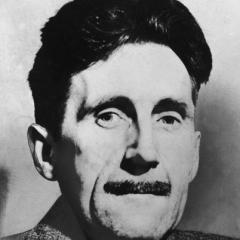
George Orwell
George Orwell

George Orwell, born Eric Arthur Blair, was a British novelist and political critic. Known for his sharp social criticism and profound insights into totalitarianism, Orwell is best remembered for his novels '1984' and 'Animal Farm', which remain influential to this day. more

You May Also Like

“The North Korean capital, Pyongyang, is a city consecrated to the worship of a father-son dynasty. (I came to think of them, with their nuclear-family implications, as 'Fat Man and Little Boy.') And a river runs through it. And on this river, the Taedong River, is moored the only American naval vessel in captivity. It was in January 1968 that the U.S.S. Pueblo strayed into North Korean waters, and was boarded and captured. One sailor was killed; the rest were held for nearly a year before being released. I looked over the spy ship, its radio antennae and surveillance equipment still intact, and found photographs of the captain and crew with their hands on their heads in gestures of abject surrender. Copies of their groveling 'confessions,' written in tremulous script, were also on show. So was a humiliating document from the United States government, admitting wrongdoing in the penetration of North Korean waters and petitioning the 'D.P.R.K.' (Democratic People's Republic of Korea) for 'lenience.' Kim Il Sung ('Fat Man') was eventually lenient about the men, but not about the ship. Madeleine Albright didn't ask to see the vessel on her visit last October, during which she described the gruesome, depopulated vistas of Pyongyang as 'beautiful.' As I got back onto the wharf, I noticed a refreshment cart, staffed by two women under a frayed umbrella. It didn't look like much—one of its three wheels was missing and a piece of brick was propping it up—but it was the only such cart I'd see. What toothsome local snacks might the ladies be offering? The choices turned out to be slices of dry bread and cups of warm water. Nor did Madeleine Albright visit the absurdly misnamed 'Demilitarized Zone,' one of the most heavily militarized strips of land on earth. Across the waist of the Korean peninsula lies a wasteland, roughly following the 38th parallel, and packed with a titanic concentration of potential violence. It is four kilometers wide (I have now looked apprehensively at it from both sides) and very near to the capital cities of both North and South. On the day I spent on the northern side, I met a group of aging Chinese veterans, all from Szechuan, touring the old battlefields and reliving a war they helped North Korea nearly win (China sacrificed perhaps a million soldiers in that campaign, including Mao Anying, son of Mao himself). Across the frontier are 37,000 United States soldiers. Their arsenal, which has included undeclared nuclear weapons, is the reason given by Washington for its refusal to sign the land-mines treaty. In August 1976, U.S. officers entered the neutral zone to trim a tree that was obscuring the view of an observation post. A posse of North Koreans came after them, and one, seizing the ax with which the trimming was to be done, hacked two U.S. servicemen to death with it. I visited the ax also; it's proudly displayed in a glass case on the North Korean side.”

“The debacle in Iraq has reinforced the realist dictum, disparaged by idealists in the 1990s, that the legacies of geography, history and culture really do set limits on what can be accomplished in any given place. But the experience in the Balkans reinforced an idealist dictum that is equally true: One should always work near the limits of what is possible rather than cynically give up on any place. In this decade idealists went too far; in the previous one, it was realists who did not go far enough.”

“The Northwestern Carpathians, in which I was raised, were a hard place, as unforgiving as the people who lived there, but the Alpine landscape into which Zlee and I were sent that early winter seemed a glimpse of what the surface of the earth looked and felt and acted like when there were no maps or borders, no rifles or artillery, no men or wars to claim possession of land, and snow and rock alone parried in a match of millennial slowness so that time meant nothing, and death meant nothing, for what life there was gave in to the forces of nature surrounding and accepted its fate to play what role was handed down in the sidereal march of seasons capable of crushing in an instant what armies might--millennia later--be foolish enough to assemble on it heights. And yet there we were, ordered to march ourselves, for God, not nature, was with us now, and God would deliver us, in this world and next, when the time came for that.”

“Michael Ledeen—a contributing editor of National Review and a Freedom Scholar at the influential neoconservative think tank American Enterprise Institute—wrote on the National Review blog in November 2006: 'I had and have no involvement with our Iraq policy'. I opposed the military invasion of Iraq before it took place.' Ledeen, however, wrote in August 2002 of 'the desperately-needed and long overdue war against Saddam Hussein' and when he was interviewed for Front Page Magazine the same month and asked, 'Okay, well if we are all so certain about the dire need to invade Iraq, then when do we do so?' Ledeen replied: 'Yesterday.' There is obvious, substantial risk in falsely claiming that one opposed the Iraq War notwithstanding a public record of support. But that war has come to be viewed as such a profound failure that that risk, at least in the eyes of some, is outweighed by the prospect of being associated with Bush's invasion.”

“The fact that in the twentieth century a greater proportion of the people in the world could communicate with one another, using English or just a few other languages, appears not to have stopped any wars, nor to have reduced the frequency with which wars have broken out, nor to have made the wars that have broken out less brutal. In fact, several murderous wars have been fought recently among people who speak 'the same language' in real terms.”