Quotessence
Home / Quotes / Quote by Jane Jacobs

Quote by Jane Jacobs

“What if we fail to stop the erosion of cities by automobiles? What if we are prevented from catalyzing workable and vital cities because the practical steps needed to do so are in conflict with the practical steps demanded by erosion? There is a silver lining to everything. In that case we Americans will hardly need to ponder a mystery that has troubled men for millennia: What is the purpose of life? For us, the answer will be clear, established and for all practical purposes indisputable: The purpose of life is to produce and consume automobiles. It is not hard to understand that the producing and consuming of automobiles might properly seem the purpose of life to the General Motors management, or that it may seem so to other men and women deeply commtted economically or emotionally to this pursuit. If they so regard it, they should be commended rather than cricicized for this remarkable identification of philosophy with daily duty. It is harder to understand, however, why the production and consumption of automobiles should be the purpose of life for this country. Similarly, it is understandable that men who were young in the 1920's were captivated by the vision of the freeway Radiant City, with the specious promise that it would be appropriate to an automobile age. At least it was then a new idea; to men of the generation of New York's Robert Moses, for example, it was radical and exciting in the days when their minds were growing and their ideas forming. Some men tend to cling to old intellectual excitements, just as some belles, when they are old ladies, still cling to the fashions and coiffures of their exciting youth. But it is harder to understand why this form of arrested mental development should be passed on intact to succeeding generations of planners and designers. It is disturbing to think that men who are young today, men who are being trained now for their carreers, should accept *on the grounds that they must be "modern" in their thinking,* conceptions about cities and traffic which are not only unworkably, but also to which nothing new of any significance has been added since their fathers were children.”

Quote by Jane Jacobs

Work

The Death and Life of Great American Cities

This influential work challenges conventional urban planning theories of the 1950s and 1960s, particularly those advocating for large-scale clearance, superblocks, and strict separation of uses. The author draws on close observation of city streets and neighborhoods to argue that vibrant, safe, and economically diverse urban areas arise from dense, mixed-use environments with short blocks and a constant flow of pedestrians. The book critiques the principles of figures like Le Corbusier and Ebenezer Howard, as well as the policies of urban renewal that devastated many existing communities. Instead, it proposes four essential generators of urban diversity and emphasizes the importance of local knowledge, informal social networks, and the intricate ballet of street life in maintaining a healthy city. The work remains a foundational text in urban studies, planning, and sociology. more

Author
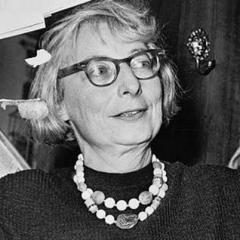
Jane Jacobs
Jane Jacobs

Jane Jacobs, an American journalist and urban theorist, was born on May 4, 1916, and passed away on April 25, 2006. She is renowned for her profound insights into urban life and her unique perspectives on urban planning. Her book, 'The Death and Life of Great American Cities,' had a revolutionary impact on modern urban planning. more

You May Also Like

“The word psychogeography, suggested by an illiterate Kabyle as a general term for the phenomena a few of us were investigating around the summer of 1953, is not too inappropriate. It does not contradict the materialist perspective of the conditioning of life and thought by objective nature. Geography, for example, deals with the determinant action of general natural forces, such as soil composition or climatic conditions, on the economic structures of a society, and thus on the corresponding conception that such a society can have of the world. Psychogeography could set for itself the study of the precise laws and specific effects of the geographical environment, whether consciously organized or not, on the emotions and behavior of individuals. The charmingly vague adjective psychogeographicalcan be applied to the findings arrived at by this type of investigation, to their influence on human feelings, and more generally to any situation or conduct that seems to reflect the same spirit of discovery. It has long been said that the desert is monotheistic. Is it illogical or devoid of interest to observe that the district in Paris between Place de la Contrescarpe and Rue de l’Arbalète conduces rather to atheism, to oblivion and to the disorientation of habitual reflexes?”

“Living in a dense environment means a less stressful and time-consuming commute to work without the aid of a car. It's about a greater sense of community and partnership that naturally develops when you walk through a place and casually collide with neighbors. It's about feeling a sense of attachment to stores and bars and restaurants and their owners and employees. Frequently I will stop in to say a hello at a restaurant or store even if I'm not shopping or eating. It's about using a compact life to reduce environmental impact. For me, it boils down to this: a place you walk through is a place you know and love.”

“The relevance of these special properties of the hippocampus and their role in map learning comes from a consideration of the massive upsurge in our use of technology for wayfinding. By focusing on the blue dot of a phone map, rather than looking about at our surroundings and making the effort to form a genuine map, we are short-circuiting the processes that we've learned to use over previous millennia. As far as finding our way is concerned, we have become striatal stimulus-response machines, racing through time and space like feverish maze mice hunting for cheese.”

“A CITY IS AS much a state of mind as a place—a set of perceptions of place. On the last train home to Mullaghbrack or Gortyfarnham or half a hundred other BallyBogMans, two farmers fall to reviewing their experiences of the big city. One has walked the streets and avenues and come away with memories of glistening steeples and dreaming spires, monuments to men of bearing and import, Palladian porticos and grand civic cupolas, pillars, piers, and palisades, and the air full of singing birds. The other has walked the same streets, yet his memories are of grey brick tenements shouldering against each other like nervous thugs; cracked fanlights, windows boarded over with card, baby carriages full of coal or potatoes, tramps in doorways, cabbage leaves underfoot, the perfume of urine and porter, pressing people with voices like flatirons. They might have visited cities continents apart, but it is the same city.”