Quotessence
Home / Quotes / Quote by Tariq Ramadan

Quote by Tariq Ramadan

“...faith must recognize the autonomy of reason and its ability to produce a rational, secular ethics. By the same criterion, reason must accept that it is legitimate for the heart, consciousness and faith to believe in an order and ends thar exist prior to its observation, discoveries and hypotheses. Once the distinction between the realms of faith and reason, and religion and science, has been accepted, it is therefore futile to debate, and still less to dispute, the hierarchy of first truths or the nature of the authority granted to their methods and their references.”

Quote by Tariq Ramadan

Work

The Quest for Meaning: Developing a Philosophy of Pluralism

This book delves into the concept of philosophical pluralism, analyzing different belief systems and their contributions to the search for meaning in life. more

Author
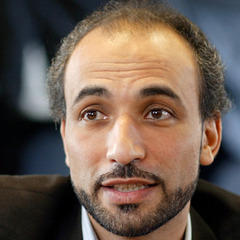
Tariq Ramadan
Tariq Ramadan

Tariq Ramadan is an Egyptian-born Swiss Islamic philosopher, writer, and academic. He is recognized for his contributions to contemporary Islamic thought and his advocacy for an Islamic reformation. Ramadan was born on August 26, 1962. more

You May Also Like

“People of great faith are almost always lacking in reason, while people possessed of great reason often suffer from a pitiful lack of faith. So it always happens that people of great faith can move the world but cannot steer it, while people possessed of great reason excel at steering the world but are hopeless at moving it”

“in the modern era, many thinkers began to mistrust faith, viewing it as 'blind' and an enemy of reason. Their watchword was 'reason alone.' One of the difficulties of this stance is that reason cannot test its own reliability, any more than soapstone can test its own hardness. Any argument, accomplished by reasoning, that what reasoning accomplishes can be trusted, would be circular, because it would take for granted the very thing that it was trying to prove. Suppose I am at the window of a burning building. Although I can hear the firemen calling to me from far below, I cannot see them because of all the smoke. They are telling me to jump. Though I may have every reason to believe that they will catch me in their net, I may not trust them enough to overcome my fear, and so, hesitating, I burn to death. Obviously, my reasons are not the same as trust; faith surpasses reason. Even so they are reasons for trust; though faith surpasses reason, it is not irrational.”

“Human reason reduced to its own resources is perfectly worthless, not only for creating but also for preserving any political or religious association, because it only produces disputes, and, to conduct himself well, man needs not problems but beliefs. His cradle should be surrounded by dogmas, and when his reason is awakened, it should find all his opinions ready-made, at least all those relating to his conduct. Nothing is so important to him as prejudices, Let us not take this word in a bad sense. It does not necessarily mean false ideas, but only, in the strict sense of the word, opinions adopted before any examination. Now these sorts of opinions are man’s greatest need, the true elements of his happiness, and the Palladium of empires. Without them, there can be neither worship, nor morality, nor government. There must be a state religion just as there is a state policy; or, rather, religious and political dogmas must be merged and mingled together to form a complete common or national reason strong enough to repress the aberrations of individual reason, which of its nature is the mortal enemy of any association whatever because it produces only divergent opinions. All known nations have been happy and powerful to the extent that they have more faithfully obeyed this national reason, which is nothing other than the annihilation of individual dogmas and the absolute and general reign of national dogmas, that is to say, of useful prejudices. Let each man call upon his individual reason in the matter of religion, and immediately you will see the birth of an anarchy of belief or the annihilation of religious sovereignty. Likewise, if each man makes himself judge of the principles of government, you will at once see the birth of civil anarchy or the annihilation of political sovereignty. Government is a true religion: it has its dogmas, its mysteries, and its ministers. To annihilate it or submit it to the discussion of each individual is the same thing; it lives only through national reason, that is to say through political faith, which is a creed. Man’s first need is that his nascent reason be curbed under this double yoke, that it be abased and lose itself in the national reason, so that it changes its individual existence into another common existence, just as a river that flows into the ocean always continues to exist in the mass of water, but without a name and without a distinct reality.”