Quotessence
Home / Quotes / Quote by Kevin Powers

Quote by Kevin Powers

“I looked out the window and saw the street and railroad tracks, the woods beyond. Beyond the woods, the county of which they were a part. And so on, until it all dissolved into the larger thing: my mother's house becoming every other house as I once had seen it, sitting atop the southern end of a broad river valley, close enough to the the mountains that every few years a scared black bear would wander down into the remaining forest, and close enough to the ocean that those early English settlers took it as the farthest point they'd go upstream, the geology of the place preventing them from having any choice other than the one wherein they said, "We are lost; therefore we will call this home." And close enough that as a child I had been teased by older kids who said if I only tried hard enough I would smell salt water, and I, believing, stood among the light poles and the gulls in the parking lots of A&Ps and cried when I knew that it was true despite the fact that they had meant to lie, as children sometimes do.”

Quote by Kevin Powers

Work

The Yellow Birds

This novel delves into the profound emotional and psychological effects of war on its characters, focusing on the experiences of soldiers returning from combat. more

Author
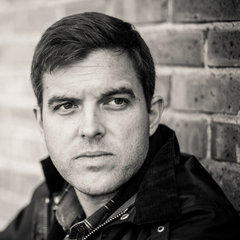
Kevin Powers
Kevin Powers

Kevin Powers, born on July 11, 1980, is an accomplished American novelist known for his works set against the backdrop of war. His writing delves into the complexities of human nature and the harsh realities of conflict, earning him critical acclaim and numerous literary awards. more

You May Also Like

“But I think parents aren't teachers anymore. Parents -- or a whole lot of us, at least -- lead by mouth instead of by example. It seems to me that if a child's hero is their mother or father -- or even better, both of them in tandem -- then the rough road of learning and experience is going to be smoothed some. And every little bit of smoothing helps, in this rough old world that wants children to be miniature adults, devoid of charm and magic and the beauty of innocence.”

“Peter Pan has to be the book of my childhood. Come to think of it, it's the book of my adulthood too. It's a book which, in the reading of it, takes me back to editions that I've had and lost, with various illustrators' work in them. It brings back moments sitting reading it with my mother. It brings back my first contact with the Disney cartoon. It brings back standing in the play-yard when I was a kid, when the wind was really blowing, and closing my eyes, spreading my arms and pretending I could fly. It brings back childhood dreams of flying. It brings back the first encounter I ever had with an invented world... Never Never Land was really the first journey I took to an invented world which I believed in wholly and completely. I remember the immense solidarity that I felt with the Lost Boys, with Peter, with the Indians - how much I wanted to be a Red Indian - how much the saving of Tiger Lily meant to me as a kid, how much I wanted to one day wake up and save an Indian squaw from drowning.”

“The door to heaven is open to us at any time we are willing to accept that we are of absolutely no importance. The bars of our own hell - the “mind-forged manacles” as Blake put it - are our attempts to justify ourselves or prove our self-worth. Accept that none of this matters and we can see that heaven is all around us. It is there in a child’s smile, in the rain that waters the earth, even in the maggots that rise in new life from dead meat. All around us is evidence that life and love are eternal and unbroken by strife and suffering.”

“Later, in my adulthood, I will read the book again, even watch the movie, and understand that I wasn’t equipped, as a child, to make room for arguments that would undermine every single choice made for me, that would shatter the foundations of my very existence. I would see that I had to believe everything I was taught, if only to survive. For a long time I wouldn’t be ready to accept that my worldview could be wrong, but I do not look back with shame at my ignorance.”