Quotessence
Home / Quotes / Quote by Victor Hugo

Quote by Victor Hugo

“What Is Love? I have met in the streets a very poor young man who was in love. His hat was old, his coat worn, the water passed through his shoes and the stars through his soul”

Quote by Victor Hugo

Work

Les Misérables

Victor Hugo's 'Les Misérables' is an epic narrative that delves into the lives of various characters, including Jean Valjean, a former convict seeking redemption, and Fantine, a woman struggling in poverty. The story is rich in historical detail and moral complexity, offering a profound examination of society's flaws and the resilience of the human spirit. more
Author

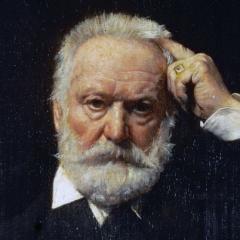
Victor Hugo
Victor Hugo

Victor Hugo, a French romantic poet, novelist, and playwright, was born on February 26, 1802, and died on May 22, 1885. He is considered one of the greatest writers in French literary history, known for his profound humanistic concerns and rich imagination. more

You May Also Like

“Mom, please don't use 'the happy voice.' It reminds me of the day Tinkles died." "Who was Tinkles?" Sue asked around a mouthful of pancake. "My cat. When I was five, Tinkles died choking on a mouse that was a bit ambitious for a kitten to eat." "It was terribly traumatic for Aurelia because it was the first time she'd experienced loss." "What did you do to help her get through it?" Rosalind smiled at Mother Guardian. "Well, after a good cry, we performed an autopsy." Aurelia reached for her mother's hand. "I never thanked you for that.”

“A rainbow is not afraid of showing its true colors because it knows it is beautiful inside out.”

“Padre Crittle: … While resting on the side of the road I saw Amah Singh, one of the oldest Sikh inhabitants of Kamaing. He was walking very slowly with the aid of a bamboo. When he saw me he stopped and begged for something to eat. “Only half a biscuit, Sahib, only half a biscuit.” I am sure that he did not believe me when I told him I hadn’t got half a biscuit in the world …”

“Lord Peter Wimsey: Facts, Bunter, must have facts. When I was a small boy, I always hated facts. Thought they were nasty, hard things, all nobs. Mervyn Bunter: Yes, my lord. My old mother always used to say... Lord Peter Wimsey: Your mother, Bunter? Oh, I never knew you had one. I always thought you just sort of came along already-made, so it were. Oh, excuse me. How infernally rude of me. Beg pardon, I'm sure. Mervyn Bunter: That's all right, my lord. Lord Peter Wimsey: Thank you. Mervyn Bunter: Yes indeed, I was one of seven. Lord Peter Wimsey: That is pure invention, Bunter, I know better. You are unique. But you were going to tell me about your mater. Mervyn Bunter: Oh yes, my lord. My old mother always used to say that facts are like cows. If you stare them in the face hard enough, and they generally run away. Lord Peter Wimsey: By Jove, that's courageous, Bunter. What a splendid person she must be. Mervyn Bunter: I think so, my lord.”

“A man's death makes everything certain about him. Of course, secrets may die with him. And of course, a hundred years later somebody looking through some papers may discover a fact which throws a totally different light on his life and of which all the people who attended his funeral were ignorant. Death changes the facts qualitatively but not quantitatively. One does not know more facts about a man because he is dead. But what one already knows hardens and becomes definite. We cannot hope for ambiguities to be clarified, we cannot hope for further change, we cannot hope for more. We are now the protagonists and we have to make up our minds.”