Quotessence
Home / Quotes / Quote by Theodore Roosevelt

Quote by Theodore Roosevelt

“Of one man in especial, beyond any one else, the citizens of a republic should beware, and that is of the man who appeals to them to support him on the ground that he is hostile to other citizens of the republic, that he will secure for those who elect him, in one shape or another, profit at the expense of other citizens of the republic… It makes no difference whether he appeals to class hatred or class interest, to religious or antireligious prejudice. The man who makes such an appeal should always be presumed to make it for the sake of furthering his own interest. The very last thing an intelligent and self-respecting member of a democratic community should do is to reward any public man because that public man says that he will get the private citizen something to which this private citizen is not entitled, or will gratify some emotion or animosity which this private citizen ought not to possess… If a public man tries to get your vote by saying that he will do something wrong in your interest, you can be absolutely certain that if ever it becomes worth his while he will do something wrong against your interest.”

Quote by Theodore Roosevelt

Work

The Duties of American Citizenship

Browse quotes and source details for this work. more

Author
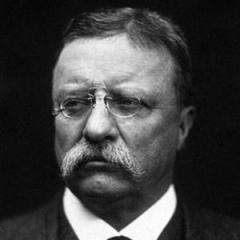
Theodore Roosevelt
Theodore Roosevelt

Theodore Roosevelt was the 26th President of the United States, serving from 1901 to 1909. A progressive leader, he is known for his advocacy of the conservation movement, expansion of federal government regulation, and efforts to improve the lives of American citizens. more

You May Also Like

“There is but one peacemaker: the Prince of Peace. He is a revolutionary: His teachings run counter to the prevailing assertion that the “other” must change. He quietly asks me to see myself as I am: messy, fallen, sinful. He gently invites me to change. Then He enables me to become, in Him, what I cannot become in and of myself. As He changes me, I experience His peace. As he changes me, I begin to understand that the “other” is my brother. As He changes me, I desire to love and serve my brother. These changes He enables in me transform me from trouble-maker to peace-maker. It is through the Prince of Peace – and through Him only – that I experience peace and become a peaceful man.”

“What the poet tells us is that, after the ordeals and adventures, after the revelation and the loss, the king must do two things: preserve the splendor of his city and tell his own story. Both tasks are complementary: both speak of the intimate connection between building a city of walls and building a story of words, and both require, in order to be accomplished, the existence of the other.”

“When destiny leads one to the frontier of his being, it makes him personally conscious that he stands before the decision either to fall back upon that which he already is or else to transcend himself. Every person is at that point led to the frontier of his being. He perceives the Other over beyond himself, and it appears to him as a possibility and awakens in him the anxiety of the potential. He sees in the mirror of the other his own limitedness, and he recoils; for at the same time this limitedness was his security, and now it is threatened. The anxiety of the potential draws him back into his bounded reality and its momentary calm. But the situation into which he will return is no longer the same. His experience of the potential and his failure toward it leaves a thorn behind, which cannot be eliminated, which can only be driven out of the consciousness by suppression. And where that occurs, there arises that spiritual phenomenon which we call fanaticism. The original meaning of the word is "divinely inspired" - that is, born out of a distraught spiritual structure and thereby destructively fulfilled. That can appear in smaller, greater or enormous measure, in persons and in groups.”

“The human mind is only capable of absorbing a few things at a time. We see what is taking place in front of us in the here and now, and cannot envisage simultaneously a succession of processes, no matter how integrated and complementary. Our faculties of perception are consequently limited even as regards fairly simple phenomena. The fate of a single man can be rich with significance, that of a few hundred less so, but the history of thousands and millions of men does not mean anything at all, in any adequate sense of the word. The symmetriad is a million—a billion, rather—raised to the power of N: it is incomprehensible. We pass through vast halls, each with a capacity of ten Kronecker units, and creep like so many ants clinging to the folds of breathing vaults and craning to watch the flight of soaring girders, opalescent in the glare of searchlights, and elastic domes which criss-cross and balance each other unerringly, the perfection of a moment, since everything here passes and fades. The essence of this architecture is movement synchronized towards a precise objective. We observe a fraction of the process, like hearing the vibration of a single string in an orchestra of supergiants. We know, but cannot grasp, that above and below, beyond the limits of perception or imagination, thousands and millions of simultaneous transformations are at work, interlinked like a musical score by mathematical counterpoint. It has been described as a symphony in geometry, but we lack the ears to hear it.”