Quotessence
Home / Quotes / Quote by Sylvia Plath

Quote by Sylvia Plath

Work

Letters of Sylvia Plath, Volume I: 1940-1956

Browse quotes and source details for this work. more

Author
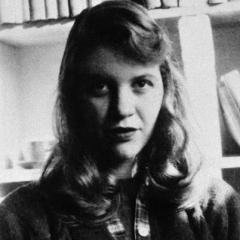
Sylvia Plath
Sylvia Plath

American poet, novelist, and playwright. Her works are known for their profound emotion and unique style, and she is considered one of the most important female writers of the 20th century. more

You May Also Like

“The really big news of the eighties is the stampede to regurgitate mildly camouflaged musical styles of previous decades, in ever-shrinking cycles of 'nostalgia. (It isn't necessary to imagine the world ending in fire or ice—there are two other possibilities: one is paperwork, and the other is nostalgia. When you compute the length of time between The Event and The Nostalgia For The Event, the span seems to be about a year less in each cycle. Eventually within the next quarter of a century, the nostalgia cycles will be so close together that people will not be able to take a step without being nostalgic for the one they just took. At that point, everything stops. Death by Nostalgia.)”

“I wrote this next song a while ago to a great American singer who died several years ago. I used to bumb into her from time to time at hotel in New York where a lot of musicians used to come. A lot of those musicians are gone. They say the era is over. They say these are now the times of the conservative, the stable, the order. Perhaps that's true. She certainly stood for something that was beyond order and beyond chaos, beyond the radical and beyond the conservative, which is what every great singer embodies. Something that is not an argument, not a philosophy. Anyway, I wrote this song for her a long time ago.”

“She had plenty of leisure now, day in, day out, to survey her life as a tract of country traversed, and at last become a landscape instead of separate fields or separate years and days, so that it became a unity and she could see the whole view, and could even pick out a particular field and wander round it again in spirit, though seeing it all the while as it were from a height, fallen in its proper place, with the exact pattern drawn round it by the hedge, and the next field into which the gap in the hedge would lead. So, she thought, could she at last put circles on her life. Slowly she crossed that day, as one crosses a field by a little path through the grasses, with the sorrel and the buttercups waving on either side; she crossed it again slowly, from breakfast to bed-time, and each hour, as one hand of the clock passed over the other, regained for her its separate character: this was the hour, she thought, when I first came downstairs that day, swinging my hat by its ribbons; this was the hour when he persuaded me into the garden, and sat with me on the seat beside the lake, and told me it was not true that with one blow of its wing a swan could break the leg of a man.”

“Nostalgia (noun) 1. The unsettling sensation that you are never able to fully access the past; that once you are departed from an event, some essential quality of it is lost forever. 2. A reminder to remember: just because the sharpness of the sadness has faded does not mean that it was not, once, terrible. It means only that time and space, creatures of infinite girth and tenderness, have stepped between the two of you, and they are keeping you safe as they were once unable to.”

“Still, the melancholy of this dying culture was all around us. Great as the desire to westernize and modernize may have been, the more desperate wish was probably to be rid of all the bitter memories of the fallen empire, rather as a spurned lover throws away his lost beloved's clothes, possessions, and photographs. But as nothing, western or local, came to fill the void, the great drive to westernize amounted mostly to the erasure of the past; the effect on culture was reductive and stunting, leading families like mine, otherwise glad of republican progress, to furnish their houses like museums.”

“The early days of springtime in New York were reliably fickle with heat rising and cool wind blowing, with shadows and rain and shimmering sunlight falling on blooms, the city one step ahead and setting the rhythm for residents trying to keep its pace. In a topsy-turvy continuous motion, it reminded them they’d somersault and skid and finally turn in the direction they ought to go.”

“Three months of moonlit nights and candlelit dinners under the starry Manhattan sky, of high times with friends and galas with acquaintances, of breakfasts at dawn and outings on Sunday afternoons, and evening strolls in Central Park where they rode the carousel and stole kisses in the Belvedere Castle like teenagers too young for love.”

“And what else is one to do when presented so unexpectedly with such stupefying intrigue but continue turning the pages back in time, a time when a wave of excess carried the American aristocracy and titled Europeans to grand ships and grander estates for extravagant parties never before seen and never seen thereafter. They stumbled onto the laps of married lovers, champagne spilling onto polished marble floors, betrayal and indecency dressed up in custom-made suits and an air of refinement honed since birth. This was the Jazz Age. The Crazy Years. Les Années Folles, as she often said.”