Quotessence
Home / Quotes / Quote by Tom Robbins

Quote by Tom Robbins

“Very well. He'd lighten up. As a matter of fact, he felt as light as the bubbly froth that flew from the lips of the waves. Whatever else his long, unprecedented life might have been, it had been fun. Fun! If others should find that appraisal shallow, frivolous, so be it. To him, it seemed now to largely have been some form of play. And he vowed that in the future he would strive to keep that sense of play more in mind, for he'd grown convinced that play--more than piety, more than charity or vigilance--was what allowed human beings to transcend evil.”

Quote by Tom Robbins

Work

Jitterbug Perfume

In this whimsical and adventurous tale, the protagonist, an eccentric perfume creator, seeks to concoct the ultimate fragrance. His quest takes him through a series of peculiar and fantastical encounters, blending elements of magic and humor with a touch of surrealism. more

Author

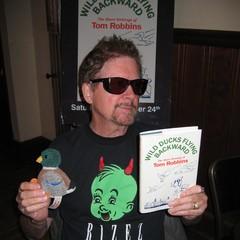
Tom Robbins
Tom Robbins

Tom Robbins (born July 22, 1936) is an acclaimed American novelist known for his whimsical, philosophical, and often surreal storytelling. His works blend pop culture, Eastern spirituality, and countercultural themes, with notable titles including 'Another Roadside Attraction' and 'Even Cowgirls Get the Blues'. Born in North Carolina, Robbins worked as a journalist and art critic before turning to fiction. His novels are celebrated for their linguistic playfulness, eccentric characters, and profound meditations on love, freedom, and the human condition. Though not a recipient of major literary prizes, he has cultivated a devoted global readership and influenced generations of writers. He remains a distinctive voice in contemporary American literature. more

You May Also Like

“Odd, don't you think? I have seen war, and invasions and riots. I have heard of massacres and brutalities beyond imagining, and I have kept my faith in the power of civilization to bring men back from the brink. And yet one women writes a letter, and my whole world falls to pieces. You see, she is an ordinary woman. A good one, even. That's the point ... Nothing [a recognizably bad person does] can surprise or shock me, or worry me. But she denounced Julia and sent her to her death because she resented her, and because Julia is a Jew. I thought in this simple contrast between the civilized and the barbaric, but I was wrong. It is the civilized who are the truly barbaric, and the [Nazi] Germans are merely the supreme expression of it.”

“In the use of force, one simplifies the situation by assuming that the evil to be overcome is clear-cut, definite, and irreversible. Hence there remains but one thing: to eliminate it. Any dialogue with the sinner, any question of the irreversibility of his act, only means faltering and failure. Failure to eliminate evil is itself a defeat. Anything that even remotely risks such defeat is in itself capitulation to evil. The irreversibility of evil then reaches out to contaminate even the tolerant thought of the hesitant crusader who, momentarily, doubts the total evil of the enemy he is about to eliminate. p. 21”

“[Gli uomini] sono gli unici, fra tutti gli esseri creati, che hanno la possibilità d'andare contro l'ordine posto da Dio nel creato: gli uomini sono cioè gli unici esseri veramente liberi, appunto perché sono liberi nei confronti di Dio... Dio aveva dovuto tollerare, ecco, aveva dovuto permettere questo male, e tutte le altre cattiverie e carognate che gli uomini fanno: e ciò per non andare contro la loro libertà. Il gran problema del male nel mondo... Appunto per non impedire la libertà dell'uomo.”