Quotessence
Home / Quotes / Quote by Charlotte Bronte

Quote by Charlotte Bronte

“And who talks of error now? I scarcely think the notion that flittered across my brain was an error. I believe it was an inspiration rather than a temptation: it was very genial, very soothing—I know that. Here it comes again! It is no devil, I assure you; or if it be, it has put on the robes of an angel of light. I think I must admit so fair a guest when it asks entrance to my heart.” “Distrust it, sir; it is not a true angel.” “Once more, how do you know? By what instinct do you pretend to distinguish between a fallen seraph of the abyss and a messenger from the eternal throne—between a guide and a seducer?” “I judged by your countenance, sir, which was troubled when you said the suggestion had returned upon you. I feel sure it will work you more misery if you listen to it.” “Not at all—it bears the most gracious message in the world: for the rest, you are not my conscience-keeper, so don’t make yourself uneasy. Here, come in, bonny wanderer!” He said this as if he spoke to a vision, viewless to any eye but his own; then, folding his arms, which he had half extended, on his chest, he seemed to enclose in their embrace the invisible being. “Now,” he continued, again addressing me, “I have received the pilgrim—a disguised deity, as I verily believe. Already it has done me good: my heart was a sort of charnel; it will now be a shrine.”

Quote by Charlotte Bronte

Work

Jane Eyre

Charlotte Brontë's 'Jane Eyre' is a poignant narrative of a young woman's journey from poverty and hardship to self-discovery and love. The story unfolds in the English countryside, where Jane's life is transformed by her employment at Thornfield Hall and her complex relationship with its enigmatic owner, Edward Rochester. The novel explores themes of social class, individualism, and the struggle for independence, while offering a rich portrayal of the human spirit. more

Author
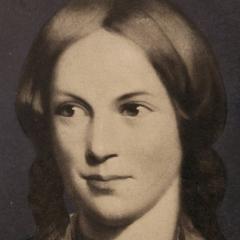
Charlotte Bronte
Charlotte Bronte

Charlotte Brontë was an English novelist known for her novel Jane Eyre, which is considered a classic of English literature. Her works are known for their deep psychological insights and emotional intensity. more

You May Also Like

“Bodily delight is a sensory experience, not any different from pure looking or the pure feeling with which a beautiful fruit fills the tongue; it is a great, an infinite learning that is given to us, a knowledge of the world, the fullness and the splendor of all knowledge...the individual...can remember that all beauty in animals and plants is a silent, enduring form of love and yearning, and he can see the animal, as he sees plants, patiently and willingly uniting and multiplying and growing, not out of physical pleasure, not out of physical pain, but bowing to necessities that are greater than pleasure and pain, and more powerful than will and withstanding. If only human beings could more humbly receive this mystery---which the world is filled with...”

“In the world of animals, pain serves an equivocal role. Parental nips and swipes are common tools in upbringing. And socially, pain is sometimes used to maintain hierarchies of dominance. But this animal use of pain seems somewhat restrained, at least in contrast with the human situation. Here the capacity for pain is often used to systematically exploit and oppress at intensities often far beyond those seen in the behaviour of our nearest primate relatives. At the same time, at least in western culture, pain is rarely used for pleasure. Is it little wonder that all pain is viewed as intrinsically evil? Or that the pain-pleasure of leatherspace has been labelled torture?”

“Jeremy Bentham startled the world many years ago by stating in effect that if the amount of pleasure obtained from each be equal there is nothing to choose between poetry and push-pin. Since few people now know what push-pin is, I may explain that it is a child's game in which one player tries to push his pin across that of another player, and if he succeeds and then is able by pressing down on the two pins with the ball of his thumb to lift them off the table he wins possession of his opponent's pin. [...] The indignant retort to Bentham's statement was that spiritual pleasures are obviously higher than physical pleasures. But who say so? Those who prefer spiritual pleasures. They are in a miserable minority, as they acknowledge when they declare that the gift of aesthetic appreciation is a very rare one. The vast majority of men are, as we know, both by necessity and choice preoccupied with material considerations. Their pleasures are material. They look askance at those who spent their lives in the pursuit of art. That is why they have attached a depreciatory sense to the word aesthete, which means merely one who has a special appreciation of beauty. How are we going to show that they are wrong? How are we going to show that there is something to choose between poetry and push-pin? I surmise that Bentham chose push-pin for its pleasant alliteration with poetry. Let us speak of lawn tennis. It is a popular game which many of us can play with pleasure. It needs skill and judgement, a good eye and a cool head. If I get the same amount of pleasure out of playing it as you get by looking at Titian's 'Entombment of Christ' in the Louvre, by listening to Beethoven's 'Eroica' or by reading Eliot's 'Ash Wednesday', how are you going to prove that your pleasure is better and more refined than mine? Only, I should say, by manifesting that this gift you have of aesthetic appreciation has a moral effect on your character.”