Quotessence
Home / Quotes / Quote by James Joyce

Quote by James Joyce

“Ineluctable modality of the visible: at least that if no more, thought through my eyes. Signatures of all things I am here to read, seaspawn and seawrack, the nearing tide, that rusty boot. Snotgreen, bluesilver, rust: coloured signs. Limits of the diaphane. But he adds: in bodies. Then he was aware of them bodies before of them coloured. How? By knocking his sconce against them, sure. Go easy. Bald he was and a millionaire, MAESTRO DI COLOR CHE SANNO. Limit of the diaphane in. Why in? Diaphane, adiaphane. If you can put your five fingers through it it is a gate, if not a door. Shut your eyes and see.”

Quote by James Joyce

Book:Ulysses

Work

Ulysses

Ulysses is a seminal work of modernist literature, written by James Joyce. The novel is renowned for its innovative narrative techniques and its portrayal of the everyday life of ordinary people in Dublin. It is divided into 18 episodes, each focusing on a different character and event, and is considered a classic of English literature. more

Author

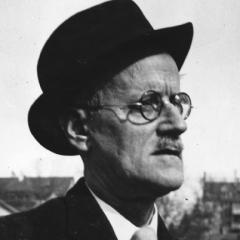
James Joyce
James Joyce

James Joyce, born on February 2, 1882, and died on January 13, 1941, was an Irish novelist and one of the greatest writers of the 20th century. Known for his unique narrative techniques and profound psychological insights, Joyce is celebrated for his contributions to modernist literature. His most famous work is 'Ulysses', which is considered one of the greatest literary works of the 20th century. Other notable works include 'Dubliners' and 'Finnegans Wake'. more

You May Also Like

“Whereas in the First World War the weakness of offensive arms led to a repudiation of imperialism and militarism, in the Fourth World War the weakness of defensive arms will dictate that every ideology become imperial, or perish. Perspective. War is a vital, life-giving, life-affirming and meaning-intensive activity, perhaps the highest, most exalted and ennobling activity for man. J.R. Nyquist "Origins of the Fourth World War”

“The logic of going downhill, the logic of decline, entails an absolute failure to bite through. It signifies a softening. It is known, as well, that soft people no longer have the stomach for what is necessary. They are focused on shopping. What occurs is a form of denial, in which the realities of politics and war are cast aside in favor of fantasy substitutes, heavily laced with ideological logos of the kind that paralyze all thought. This intellectual failure, born out of spiritual collapse, heralds the end of rational calculation and grand strategy. One does not need strategy to win. Merely, the right kind of publicity is all-in-all sufficient. When something tangible occurs, which may be strategically fatal, the answer is to revile the opposition. There is no analysis, no judgment, no genuine fright at the prospect of death and destruction. Few are those who believe that real destruction is possible. Few suspect that weapons of mass destruction can and will be used against people who are too silly to know, and too careless to consider, who is preparing these weapons against them. Soft people imagine that such weapons cannot be used because the world would end. And nobody wants that. Here is a failure of imagination alongside a dismissal of the concept "enemy," done without any hesitation, with the survival instinct overridden by the daily corruption that attends absolute comfort. Those who are soft cannot see into an enemy that emerges from totally different conditions of life.”

“In my books, The Origins of the Fourth World War as well as The Fool and His Enemy, I argue that we are experiencing a civilization-altering spiritual/intellectual change. A New Religion is now displacing traditional Christianity and its adjunct in classical pagan teachings (i.e., Plato, Aristotle, Thucydides, Cicero, etc.). The New Religion inverts the terms of man’s existence. The New Religion inverts sexuality, rank order, economic principles and morality. The elimination of Christianity as the ruling religion today is strikingly similar to the elimination of paganism as the ruling religion during the fourth century (insofar as it portends the outright destruction of civilization itself). J.R. Nyquist”