Quotessence
Home / Quotes / Quote by Yukio Mishima

Quote by Yukio Mishima

“Kazu, now that she thought of it, realized that for all her headstrong temperament, she had never loved a man younger than herself. A young man has such a surplus of spiritual and physical gifts that he is likely to be cocksure of himself, particularly when dealing with an older woman, and there is no telling how swelled up with self-importance he may become. Besides, Kazu felt a physical repugnance for youth. A woman is more keenly aware than a man of the shocking disharmony between a young man's spiritual and physical qualities, and Kazu had never met a young man who wore his youth well. She was moreover repelled by the sleekness of a young man's skin.”

Quote by Yukio Mishima

Work

After The Banquet

This book delves into the complexities of human relationships and political machinations that unfold in the aftermath of a grand banquet. The narrative likely examines the dynamics of power struggles and hidden agendas among the characters present at the event. more

Author

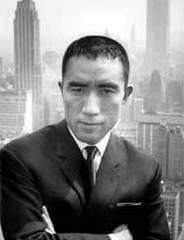
Yukio Mishima
Yukio Mishima

Yukio Mishima was a Japanese author and playwright, a prominent figure in post-war Japanese literature. His works, characterized by a fusion of traditional Japanese aesthetics and modernist techniques, often explored themes of tradition, ritual, and the samurai code. more

You May Also Like

“The great fact all the while however had been the incalculability; since he had supposed himself, from decade to decade, to be allowing, and in the most liberal and intelligent manner, for brilliancy of change. He actually saw that he *had* allowed for nothing; he missed what he would have been sure of finding, he found what he would never have imagined. Proportions and values were upside-down; the ugly things he had expected, the ugly things of his far away youth, when he had too promptly waked up to a sense of the ugly--these uncanny phenomena placed him rather, as it happened, under the charm; whereas the 'swagger' things, the modern, the monstrous, the famous things, those he had more particularly, like thousands of ingenuous enquirers every year, come over to see, were exactly his sources of dismay. They were as so many set traps for displeasure, above all for reaction, of which his restless tread was constantly pressing the spring. It was interesting, doubtless, the whole show, but it would have been too disconcerting hadn't a certain finer truth saved the situation. He had distinctly not, in this steadier light, come over *all* for the monstrosities; he had come, not only in the last analysis but quite on the face of the act, under an impulse with which they had nothing to do. ("The Jolly Corner")”