Quotessence
Home / Quotes / Quote by Dietrich Bonhoeffer

Quote by Dietrich Bonhoeffer

“If we would answer the question of the existence of the Evil then we would not be sinners, we could make something else responsible.”

Quote by Dietrich Bonhoeffer

Author
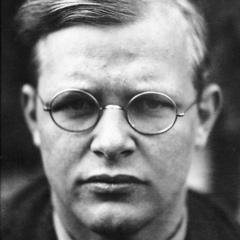
Dietrich Bonhoeffer
Dietrich Bonhoeffer

German pastor, theologian, philosopher, and member of the resistance against the Nazis. Born on February 4, 1906, in Germany, he was executed on April 9, 1945 in a concentration camp. more

You May Also Like

“Not everything that happens during the day is an open portending a good or evil development in the future, but everything has meaning to one degree or another, for the world is an ever-weaving tapestry from which no thread can be pulled without destroying the integrity of the cloth. The breadth of Creation makes it impossible for us to step back far enough to see the story that the tapestry tells; the intricacy of it, from the macro to the micro to the subatomic, make sit impossible for us to comprehend the megatrillions of connections between the threads in just one small fragment of the whole.”

“It is a proper and excellent thing for infinite glory to shine forth; and for the same reason, it is proper that the shining forth of God's glory should be complete; that is, that all parts of his glory should shine forth, that every beauty should be proportionably effulgent, that the beholder may have a proper notion of God.” Thus it is necessary, that God's awful majesty, his authority and dreadful greatness, justice, and holiness, should be manifested. But this could not be, unless sin and punishment had been decreed; so that the shining forth of God's glory would be very imperfect, both because these parts of divine glory would not shine forth as the others do, and also the glory of his goodness, love, and holiness would be faint without them; nay, they could scarcely shine forth at all.”

“At some level, it is even tempting to think that since strict materialism is among the most incoherent of superstitions - one that has never really asked the question of the being of things in any depth or with any persistence, or one that has at best attempted to conjure that question away as a fallacy of grammar - it is incapable of imagining any conception of God more sophisticated than its own. The materialist encounters an instance of unjust suffering and, by a sort of magical thinking, concludes from the absence of any immediately visible moral order that there must be nothing transcendent of material causality, in much the same way that certain of our more remote, primitive ancestors might have seen a flash of lightning in the sky and concluded that some god must have flung it from on high. In neither case does the conclusion follow from the evidence (though in the latter case the reasoning is somewhat more rigorous); and in neither case is the god at issue much more than an affective myth.”

“Clowns to the left of me, jokers to the right, here I am -- not stuck in the middle, but hovering above the entire farcical spectrum, weeping as I behold my fellow man's devotion to political illusion and self-destruction.”