Quotessence
Home / Quotes / Quote by Joseph Conrad

Quote by Joseph Conrad

Work

Heart of Darkness

Joseph Conrad's 'Heart of Darkness' is a seminal work that delves into the dark underbelly of colonialism and the psychological impact of exploration. The narrative follows Marlow, a seaman, as he navigates the treacherous Congo River and encounters the enigmatic Mr. Kurtz. more
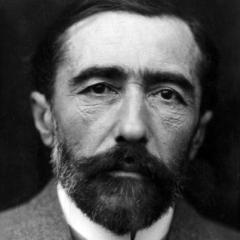
Author

Joseph Conrad
Joseph Conrad

Joseph Conrad, born on December 3, 1857 in Poland and died on August 3, 1924 in the United Kingdom, was a renowned British author of the late 19th and early 20th centuries. He is known for his profound descriptions of maritime life and his insightful explorations of human nature. more

You May Also Like

“He was just a word for me. I did not see the man in the name any more than you do. Do you see him? Do you see the story? Do you see anything? It seems to me I am trying to tell you a dream - making a vein attempt, because no relation of a dream can convey the dream-sensation, that commingling of absurdity, surprise, and bewilderment in a tremor of struggling revolt, that notion of being captured by the incredible which is of the very essence of dreams... No, it is impossible; it is impossible to convey the life-sensation of any given epoch of one's existence - that which makes its truth, its meaning - its subtle and penetrating essence. We live, as we dream, alone...”

“They were conquerors, and for that you want only brute force—nothing to boast of, when you have it, since your strength is just an accident arising from the weakness of others. They grabbed what they could get for the sake of what was to be got. It was just robbery with violence, aggravated murder on a great scale, and men going at it blind—as is very proper for those who tackle a darkness. The conquest of the earth, which mostly means the taking it away from those who have a different complexion or slightly flatter noses than ourselves, is not a pretty thing when you look into it too much. What redeems it is the idea only. An idea at the back of it; not a sentimental pretence but an idea; and an unselfish belief in the idea—something you can set up, and bow down before, and offer a sacrifice to....”

“High school teachers and college professors who have discussed this book in thousands of classrooms over the years tend to do so in terms of Freud, Jung, and Nietzche; of classical myth, Victorian innocence, and original sin; of postmodernism, postcolonialism, and poststrucuralism. European and American readers, not comfortable acknowledging the genocidal scale of killing Africa at the turn of the century, have cast Heart of Darkness loose from its historical moorings. We read it as a parable for all times and places, not as a book about one time and place.”

“His eyes, of the usual blue, were perhaps remarkably cold, and he certainly could make his glance fall on one as trenchant and heavy as an ax. But even at these times the rest of his person seemed to disclaim the intention. Otherwise there was only an indefinable, faint expression of his lips, some- thing stealthy--a smile--not a smile--I remember it, but I can't explain. It was unconscious, this smile was, though just after he had said something it got intensified for an instant. It came at the end of his speeches like a seal applied on the words to make the meaning of the commonest phrase appear absolutely inscrutable.”