Quotessence
Home / Quotes / Quote by Marcel Proust

Quote by Marcel Proust

“And from that instant I did not have to take another step; the ground moved forward under my feet in that garden where for so long my actions had ceased to require any control, or even attention, from my will. Habit had come to take me in her arms and carry me all the way up to my bed like a little child.”

Quote by Marcel Proust

Book:Combray

Work

Combray

Browse quotes and source details for this work. more

Author

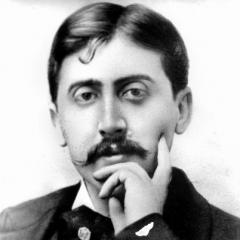
Marcel Proust
Marcel Proust

Marcel Proust was a French novelist renowned for his magnum opus, 'In Search of Lost Time'. This novel is considered a classic of 20th-century literature, known for its intricate psychological portrayals and profound exploration of memory. more

You May Also Like

“A letter from 15 year old Sophia - later Catherine the Great - to her father: My Lord: I beg you to assure yourself that your advice and exhortation will remain forever engraved on my heart, as the seeds of the holy faith will in my soul, to which I pray God to lend all the strength it will need to sustain me through the temptations to which I expect to be exposed... I hope to have the consolation of being worthy of it, and likewise of continuing to receive good news of my dear Papa, and I am, as long as I live, and in an inviolable respect, my lord, your Highness's most humble, most obedient, and faithful daughter and servant, Sophia.”

“Running away was not like it was in stories. People did not try and stop you. They did not give chase. The thing people didn't understand was that you had to decide what you were running away from. Most of the time it wasn't mothers or fathers or monsters or villains; most of the time you were running away from that little voice inside your head, the one telling you to stay where you are, that everything will turn out all right.”

“From that night the thousand streets ran as one street, with imperceptible corners and changes of scene, broken by intervals of begged and stolen rides, on trains and trucks, and on country wagons with he at twenty and twentyfive and thirty sitting on the seat with his still, hard face and the clothes (even when soiled and worn) of a city man and the driver of the wagon not knowing who or what the passenger was and not daring to ask. The street ran into Oklahoma and Missouri and as far south again as Mexico and then back north to Chicago and Detroit and then back south again and at last to Mississippi. It was fifteen years long.”

“They did not use the sonic stunners but the foray gun, the ancient weapon that fires a set of metal fragments in a burst. They shot to kill him. He was dying when I got to him, sprawled and twisted away from his skis that stuck up out of the snow, his chest half shot away. I took his head in my arms and spoke to him, but he never answered me; only in a way he answered my love for him, crying out through the silent wreck and tumult of his mind as consciousness lapsed, in the unspoken tongue, once, clearly, 'Arek!' Then no more. I held him, crouching there in the snow, while he died. They let me do that. Then they made me get up, and took me off one way and him another, I going to prison and he into the dark.”