Quotessence
Home / Quotes / Quote by James Carlos Blake

Quote by James Carlos Blake

Work

Country of the Bad Wolfes

Browse quotes and source details for this work. more

Author
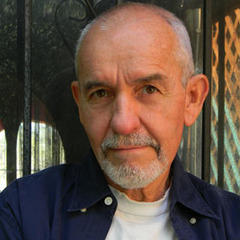
James Carlos Blake
James Carlos Blake

James Carlos Blake, born on May 26, 1947, is an accomplished writer whose works span various literary genres, including novels, poetry, and drama. Known for his profound themes and rich emotional expression, Blake's writing has garnered a wide readership. more

You May Also Like

“They did not use the sonic stunners but the foray gun, the ancient weapon that fires a set of metal fragments in a burst. They shot to kill him. He was dying when I got to him, sprawled and twisted away from his skis that stuck up out of the snow, his chest half shot away. I took his head in my arms and spoke to him, but he never answered me; only in a way he answered my love for him, crying out through the silent wreck and tumult of his mind as consciousness lapsed, in the unspoken tongue, once, clearly, 'Arek!' Then no more. I held him, crouching there in the snow, while he died. They let me do that. Then they made me get up, and took me off one way and him another, I going to prison and he into the dark.”

“No one wants to learn an instrument, Rachel. It's grueling repetition. And besides, you're too old to start. Concert violinists who learn the traditional way begin when they're six or seven." Risa can't help but listen to the irritating conversation taking place between the well-dressed woman and her fashionably disheveled teenage daughter. "It's bad enough they'd be messing in my brain and giving me a NeuroWeave," the girl whines. "But why do I have to have the hands, too? I like my hands!" The mother laughs. "Honey, you've got your father's stubby, chubby little fingers. Trading up will only do you good in life, and it's common knowledge that a musical NeuroWeave requires muscle memory to complete the brain-body connection." "There are no muscles in the fingers!" the girl announces triumphantly. "I learned that in school." The mother gives her a long-suffering sigh. "Think of them like a pair of gloves, Rachel. Fancy silk gloves, like a princess wears." Risa can't stand it anymore. Making sure she's low enough so that her face can't be seen, she gets up, and as she walks past them, she says, "You'll have someone else's fingerprints.”

“The profilers’ plan to coax me out of the woods resembled a comedy skit. During their search of my Cane Creek trailer, the feds had found dozens of books on the Civil War. And interviews with my friends confirmed that I was a bona fide Civil War buff. The profilers looked at all this Civil War “stimuli” and concluded that my hiding in the mountains was a form of role-playing. Starring in my own Civil War fantasy, I was a lone rebel fighting for the Lost Cause, and the task force was a Yankee army out to capture me. To talk On August 16, the task force pulled out of the woods while Bo and his rebels went in. They had to look the part, so the FBI profilers dressed them in white hats with the word “REBEL” stenciled in red letters across the front; and around their neck each rebel wore a Confederate flag bandanna.me into surrendering, they needed some of my rebel comrades to convince me that the war was over and it was time to lay down my arms. Colonel Gritz and his crew were assigned the role of my rebel comrades. They were there to “rescue” me from the Yankee horde. Bo’s band of rebels pitched camp down in Tusquitee, north of the town of Hayesville. Beginning at Bob Allison Campground – the place where I’d abandoned Nordmann’s truck – they worked their way west into the Tusquitee Mountains. They walked the trails, blowing whistles and yelling “Eric, we’re here with Bo Gritz to save you.” They searched for a week. I lost it when I heard on the radio that the profilers had dressed Gritz’s clowns in “REBEL” hats and Confederate flag bandannas. I laughed so hard I think I broke a rib.”

“Rejecting Jesus Christ is like a fugitive who spends all day running but has nowhere to hide; you will face him after death. He is the only judge and jury.”

“He was as bold as a lion about it, and 'mightily convinced' not only himself, but everybody that heard him;—but then his idea of a fugitive was only an idea of the letters that spell the word,—or at the most, the image of a little newspaper picture of a man with a stick and bundle, with "Ran away from the subscriber" under it. The magic of the real presence of distress,—the imploring human eye, the frail, trembling human hand, the despairing appeal of helpless agony,—these he had never tried. He had never thought that a fugitive might be a hapless mother, a defenseless child,—like that one which was now wearing his lost boy's little well-known cap; and so, as our poor senator was not stone or steel,—as he was a man, and a downright noble-hearted one, too,—he was, as everybody must see, in a sad case for his patriotism.”

“The thing I hated most about moving was having to buy everything all over again; all the household objects, from furniture to silverware, that you find in any home. Normally, you buy them with the idea that they are going to last over time, be part of your everyday life, and have a history. For a fugitive, it’s different: the only criterion is temporary use, and so each and every object necessarily loses its worth. I thought of them as non-objects, the non-possessions of a non-person living a non-life.”