Quotessence
Home / Quotes / Quote by Sophocles

Quote by Sophocles

“Take these things to heart, my son, I warn you. All men make mistakes, it is only human. But once the wrong is done, a man can turn his back on folly, misfortune too, if he tries to make amends, however low he's fallen, and stops his bullnecked ways. Stubbornness brands you for stupidity - pride is a crime.”

Quote by Sophocles

Work

Antigone

This renowned work explores themes of justice, morality, and the conflict between individual conscience and the state. It tells the story of Antigone, who defies the king's decree and buries her brother, leading to a series of tragic events. more

Author

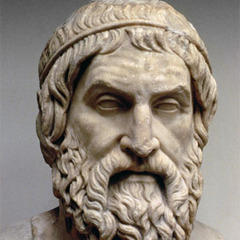
Sophocles
Sophocles

Sophocles, born in 498 BC and died in 406 BC, was a renowned Greek tragic playwright. He is one of the three greatest tragic poets of ancient Greece, alongside Aeschylus and Euripides. Sophocles' works profoundly revealed the complexity of human nature and social contradictions, exerting a profound influence on subsequent drama. more

You May Also Like

“The personality of Muhammad, it is most difficult to get into the whole truth of it. Only a glimpse of it I can catch. What a dramatic succession of picturesque scenes! There is Muhammad, the Prophet; there is Muhammad, the Warrior; Muhammad, the Businessman; Muhammad, the Statesman; Muhammad, the Orator; Muhammad, the Reformer; Muhammad, the Refuge of Orphans; Muhammad, the Protector of Slaves; Muhammad, the Emancipator of Women; Muhammad, the Judge; Muhammad, the Saint. All in all these magnificent roles, in all these departments of human activities, he is like a hero.”

“There is something about the very idea of a city which is central to the understanding of a planet like Earth, and particularly the understanding of that part of the then-existing group-civilization which called itself the West. That idea, to my mind, met its materialist apotheosis in Berlin at the time of the Wall. Perhaps I go into some sort of shock when I experience something deeply; I'm not sure, even at this ripe middle-age, but I have to admit that what I recall of Berlin is not arranged in my memory in any normal, chronological sequence. My only excuse is that Berlin itself was so abnormal - and yet so bizarrely representative - it was like something unreal; an occasionally macabre Disneyworld which was so much a part of the real world (and the realpolitik world), so much a crystallization of everything these people had managed to produce, wreck, reinstate, venerate, condemn and worship in their history that it defiantly transcended everything it exemplified, and took on a single - if multifariously faceted - meaning of its own; a sum, an answer, a statement no city in its right mind would want or be able to arrive at.”