Quotessence
Home / Quotes / Quote by Victor Hugo

Quote by Victor Hugo

“Là, au milieu du pavé, — il était midi, — un grand soleil, — une créature dansait. Une créature si belle que Dieu l’eût préférée à la Vierge, et l’eût choisie pour sa mère, et eût voulu naître d’elle si elle eût existé quand il se fit homme !”

Quote by Victor Hugo

Work

Notre-Dame de Paris

Victor Hugo's Notre-Dame de Paris is a historical novel that delves into the life of Quasimodo, a deformed bell-ringer in the iconic Notre-Dame Cathedral. The story is rich with historical detail and vividly portrays the social and religious tensions of the time. more

Author

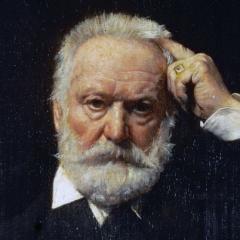
Victor Hugo
Victor Hugo

Victor Hugo, a French romantic poet, novelist, and playwright, was born on February 26, 1802, and died on May 22, 1885. He is considered one of the greatest writers in French literary history, known for his profound humanistic concerns and rich imagination. more

You May Also Like

“But there it was- crackling inside my veins. Crackling beside veins of ice, and water. And darkness. Embers flared around us, floating in the air, and I sent out a breath of soothing dark, a breath of ice and water, as if it were a wind- a wind at dawn, sweeping clean the world. The power did not belong to the High Lords. Not any longer. It belonged to me- as I belonged only to me, as my future was mine to decide, to forge. Once I discovered and mastered what the others had given me, I could weave them together- into something new, something of every court and none of them.”

“Virtue only needs to be worshipped; it follows the path to happiness...it must be so, a thousand arms open to receive its devotees, if they are pursued by adversity. But everybody deserts the guilty man...one blushes at one's attachment to him or at the tears one sheds for him, there is a fear of contagion, he is banished from everybody's hearts, and one condemns out of pride the man one ought to help out of humanity.”

“In Scappi's cookbook we see the first Italian recipes ever published that rely heavily on dairy, particularly butter and cheeses. There are also numerous recipes for pasta. Turkey makes its first appearance in an Italian cookbook. And many of us today are familiar with a recipe first found in L'Opera: zabaglione. The flavors that are prevalent in the cookbook are a little cloying to modern audiences, relying heavily on rosewater, sugar, pepper, ginger, nutmeg, and cinnamon. These flavors make sense in the variety of flaky pastries that are described in the book, but can be a little more off-putting when incorporated into a savory pasta dish.”

“Stella. I cannot wait to see her and hold her in my arms once more. I long for my stellina. I worry that the distance between us will someday create cracks in our love that cannot be mended. Our time together sometimes seems thin, like a spice or other flavor is missing. I need to think of something I can do more to seal our love together, to rekindle our fire so we will always long for each other.”

“Six horses waited, adorned in the red and black of the Company of Cooks and harnessed to an open, canopied wagon festooned with ribbons. Upon it lay Bartolomeo's casket, draped with a cloth embroidered with the company's coat of arms. A bear was on the left side of the crest and a stag on the right. Below the central chevron and its two red stars were the tools of the company's trade, a crossed knife and a butcher's knife. The banner beneath bore a Latin phrase coined by Horace- ab ovo usque ad mala- embroidered in gold. From eggs to apples, beginning to end. Roman meals had always begun with eggs and ended with fruit.”

“Surely she knows the effect she has on me, he thought. He was close enough to smell her orange blossom perfume. Oh! What a glorious scent. He brought himself back into focus, leaned in, and with the large serving tongs carefully lifted the lobster from the tray. Dear Lord, guide my hand. Do not let me make a fool of myself this day. Do not let me flip the spoon into her lap, please, please, guide my hand. Not a crumb of lobster's stuffing escaped as he laid it gently upon the exquisite maiolica plate decorated with scenes of pastoral life. Relief. "Thank you," she said again. Her soft voice was a chorus of angels. She touched his arm in thanks and a thrill ran through him. He wanted nothing more than to lean down and brush her white neck with his lips, but instead he departed before she could see the heat of embarrassment rising to his cheeks.”