Quotessence
Home / Quotes / Quote by Shunryu Suzuki

Quote by Shunryu Suzuki

Work

Zen Mind, Beginner's Mind: Informal Talks on Zen Meditation and Practice

This book presents a series of informal talks by Shunryu Suzuki, a prominent Zen Buddhist teacher, focusing on the practice of Zen meditation and its principles. Suzuki's teachings emphasize the importance of mindfulness and the beginner's mind, encouraging readers to approach their practice with openness and simplicity. more

Author
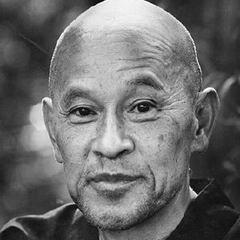
Shunryu Suzuki
Shunryu Suzuki

Shunryu Suzuki, born on May 18, 1904, was a renowned Zen master from Japan. He played a significant role in spreading Zen culture in the Western world. more

You May Also Like

“My four things I care about are truth, meaning, fitness and grace. [...] Sam [Harris] would like to make an argument that the better and more rational our thinking is, the more it can do everything that religion once did. [...] I think about my personal physics hero, Dirac – who was the guy who came up with the equation for the electron, less well-known than the Einstein equations but arguably even more beautiful...in order to predict that, he needed a positively-charged and a negatively-charged particle, and the only two known at the time were the electron and the proton to make up, let's say, a hydrogen atom. Well, the proton is quite a bit heavier than the electron and so he told the story that wasn't really true, where the proton was the anti-particle of the electron, and Heisenberg pointed out that that couldn't be because the masses are too far off and they have to be equal. Well, a short time later, the anti-electron -- the positron, that is -- was found, I guess by Anderson at Caltech in the early 30s and then an anti-proton was created some time later. So it turned out that the story had more meaning than the exact version of the story...so the story was sort of more true than the version of the story that was originally told. And I could tell you a similar story with Einstein, I could tell it to you with Darwin, who, you know, didn't fully understand the implications of his theory, as is evidenced by his screwing up a particular kind of orchid in his later work...not understanding that his theory completely explained that orchid! So there's all sorts of ways in which we get the...the truth wrong the first several times we try it, but the meaning of the story that we tell somehow remains intact. And I think that that's a very difficult lesson for people who just want to say, 'Look, I want to'...you know, Feynman would say, "If an experiment disagrees with you, then you're wrong' and it's a very appealing story to tell to people – but it's also worth noting that Feynman never got a physical law of nature and it may be that he was too wedded to this kind of rude judgment of the unforgiving. Imagine you were innovating in Brazilian jiu-jitsu. The first few times might not actually work. But if you told yourself the story, 'No, no, no – this is actually genius and it's working; no, you just lost three consecutive bouts' -- well, that may give you the ability to eventually perfect the move, perfect the technique, even though you were lying to yourself during the period in which it was being set up. It's a little bit like the difference between scaffolding and a building. And too often, people who are crazy about truth reject scaffolding, which is an intermediate stage in getting to the final truth.”

“Good reasoning isn't primarily about being loud and confident and good on your feet. Those are skills worth developing⁠—as humans, we're built to respond to all of that⁠—but those aren't the things that make people good reasoners. The right-wing Logic Brigades give people the impression that caring about logic means dogmatically applying a few simple principles to everything and ignoring the fine-grained contextual differences between superficially similar situations. That's exactly wrong. If you actually care about getting the arguments right, you need to slow the hell down and pay attention to the subtleties.”

“Before we discuss intuition in greater detail, let us first dispel the myths that intuition is some kind of a ‘fluke’ of nature. I would like you to understand that intuition is a skill that can be developed just as any other skills that you acquire. It comes from you, from no one else! Because we have not experienced that zone, that part, that dimension of our being, we have forgotten it. - HDH Bhagawan Sri Nithyananda Paramashivoham, in the book "Living Enlightenment".”

“Life is an unforgettable journey. A journey where you plan things but the timings are planned by someone else. A journey where you set the goals but the day you achieve them are planned by the best of the planners. So we need to keep our dreams and passion alive. If they stay alive one day we will get them in the best of ways. Then when we will look back and search it will be revealed that every stupid move was a step forward, every tough time was a preparation and every delay was an attempt to fine tune the results.”

“Marcuse's own highhanded scorn about those whom he criticizes makes it not inapposite to remark that the arguments which I have been deploying are very elementary ones, familiar to every student with the barest knowledge of logic. The suspicion is thus engendered that not only Marcuse but also Adorno and Horkheimer actually do not know any logic, and it is certainly the case that, if they do know any, all three have taken some pains to conceal their knowledge of the subject which they are professedly criticizing.”