Quotessence
Home / Quotes / Quote by John Calvin

Quote by John Calvin

“Nearly all the wisdom we possess, that is to say, true and sound wisdom, consists of two parts: the knowledge of God and of ourselves. But, while joined by many bonds, which one precedes and brings forth the other is not easy to discern.”

Quote by John Calvin

Author
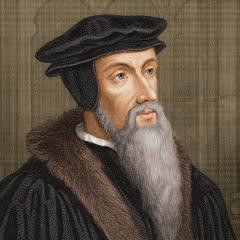
John Calvin
John Calvin

John Calvin (July 10, 1509 - May 27, 1564) was a significant figure in the 16th-century Protestant Reformation and the founder of the Calvinist branch of Protestantism. He was a theologian, philosopher, and Christian reformer whose theological ideas had a profound impact on subsequent generations. more

You May Also Like

“In the Toll Booth, Margaret knelt down to pray. Even now they could not leave her in peace, but - after all that had happened! - bade her to pray and they would pray with her. To consent would have been taken as a surrender of all for which she was giving her life. It was no time to mince words, so she answered roundly: "I will not pray with you, nor shall you pray with me; neither will I say Amen to your prayers, nor shall you to mine." What fellowship has light with darkness?”

“Protestantism's evolution away from hierarchy and authority has enormous consequences for America and the world. On the one hand, the democratization of religion runs parallel to political democratization. The king of England, questioning the pope, inspires English subjects to question the king and his Anglican bishops. Such dissent is backed up by a Bible full of handy Scripture arguing for arguing with one's kIng. This is the root of self-government in the English-speaking world. On the other hand, Protestantism's shedding away of authority, as evidenced by my [Pentecostal] mother's proclamation that I needn't go to church or listen to a preacher to achieve salvation, inspires self-reliance—along with a dangerous disregard for expertise. So the impulse that leads to democracy can also be the downside of democracy—namely, a suspicion of people who know what they are talking about. It's why in U.S. presidential elections the American people will elect a wisecracking good ol' boy who's fun in a malt shop instead of a serious thinker who actually knows some of the pompous, brainy stuff that might actually get fewer people laid off or killed.”

“…one main point in Luther's teachings was his emphasis on the evilness of human nature, the uselessness of his will and of his efforts. Calvin placed the same emphasis on the wickedness of man and put in the center of his whole system the idea that man must humiliate his self-pride to the utmost; and furthermore, that the purpose of man’s life is exclusively God's glory and nothing of his own. Thus Luther and Calvin psychologically prepared man for the role which he had to assume in modern society: of feeling his own self to be insignificant and of being ready to subordinate his life exclusively for purposes which were not his own. Once man was ready to become nothing but the means for the glory of a God who represented neither justice nor love, he was sufficiently prepared to accept the role of a servant to the economic machine—and eventually a “Führer.”

“In capitalism economic activity, success, material gains, become ends in themselves. It becomes man’s fate to contribute to the growth of the economic system, to amass capital, not for purposes of his own happiness or salvation; but as an end in itself. Man became a cog in the vast economic machine—an important one if he had much capital, an insignificant one if he had none—but always a cog to serve a purpose outside of himself. This readiness for submission of one’s self to extra-human ends was actually prepared by Protestantism, although nothing was further from Luther's or Calvin’s mind than the approval of such supremacy of economic activities. But in their theological teaching they had laid the ground for this development by breaking man’s spiritual backbone, his feeling of dignity and pride, by teaching him that activity had no further aims outside himself.”