Quotessence
Home / Quotes / Quote by Robert Penn Warren

Quote by Robert Penn Warren

“I thought God cannot be Fullness of Being. For Life is Motion.----- For Life is Motion toward Knowledge. If God is Complete Knowledge then He is Complete Non-Motion, which is Non-Life, which is Death. Therefore, if there is such a God of Fullness of Being, we would worship Death, the Father.”

Quote by Robert Penn Warren

Work

All the King's Men

Robert Penn Warren's classic novel follows the rise and fall of a charismatic politician named Willie Stark, whose journey through the political landscape of Louisiana is marked by ambition, manipulation, and moral decay. more

Author

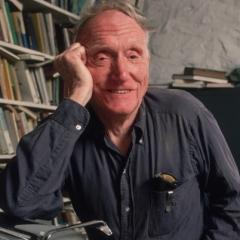
Robert Penn Warren
Robert Penn Warren

Robert Penn Warren was an American poet, novelist, and literary critic. His works are known for their profound social insight and unique portrayal of Southern culture. Warren's poetry and novels have won numerous literary awards, including the Pulitzer Prize for Poetry in 1947 and the Pulitzer Prize for Fiction in 1955. more

You May Also Like

“Of course it's juggling,” the man in motley was saying [...] “You know what your problem is, Sir Grenall? You've been seduced by the lure of spectacle. Sure, I could juggle three or four balls and use two hands, and that would be very impressive, but then what would I do after that? Five balls? Three hands? You see how it goes? Now me, I'm an artist, trying to recapture the original purity of the art form. This” - the man nodded at the ball he tossing up and down - “this is the essence of juggling.”

“We're always taught that God wants us to always only say "I can't do this without You God" , "Whatever your will is God, that's my will too" but God says He is a father, and there is no good father who wants his children to have no will and to think that they can't stand on their own two feet. So maybe what you should be saying is "I can do it" and "I have a strong will, I know what I want." When you think God's left you and wants you to be sitting like a duck, maybe He's actually believing in you, teaching you how to fly.”

“Q: Do you feel concerned that after all this work, people won't treat [Starship Titanic] with the gravity of, say, a movie or a book? That they won't treat it as an art form? D.A.: I hope that's the case, yes. I get very worried about this idea of art. Having been an English literary graduate, I've been trying to avoid the idea of doing art ever since. I think the idea of art kills creativity. ... [I]f somebody wants to come along and say, "Oh, it's art," that's as may be. I don't really mind that much. But I think that's for other people to decide after the fact. It isn't what you should be aiming to do. There's nothing worse than sitting down to write a novel and saying, "Well, okay, I'm going to do something of high artistic worth." ... I think you get most of the most interesting work done in fields where people don't think they're doing art, but merely practicing a craft, and working as good craftsmen. ... I tend to get very suspicious of anything that thinks it's art while it's being created.”

“If a painting really works down in your heart and changes the way you see, and think, and feel, you don't think, 'oh, I love this picture because it's universal.' 'I love this painting because it speaks to all mankind.' That's not the reason anyone loves a piece of art. It's a secret whisper from an alleyway. Psst, you. Hey kid. Yes, you. ... You see one painting, I see another, the art book puts it at another remove still, the lady buying the greeting card at the museum gift shop sees something else entirely, an that's not even to mention the people separated from us by time -four hundred years before us, four hundred years after we're gone- it'll never strike anybody the same way and the great majority of people it'll never strike in any deep way at all but- a really great painting is fluid enough to work its way into the mind and heart through all kinds of different angles, in ways that are unique and very particular. Yours, yours. I was painted for you.”

“Yang indah memang bisa menghibur selama-lamanya, membubuhkan luka selama-lamanya, meskipun puisi dan benda seni bisa lenyap. Ia seakan-akan roh yang hadir dan pergi ketika kata dilupakan dan benda jadi aus. Tapi apa arti roh tanpa tubuh yang buncah dan terbelah? Keindahan tak bisa jadi total. Ketika ia merangkum total, ia abstrak, dan manusia dan dunia tak akan saling menyapa lagi.”