Quotessence
Home / Quotes / Quote by Leo Tolstoy

Quote by Leo Tolstoy

“In actuality, it was like the homes of all people who are not really rich but who want to look rich, and therefore end up looking like one another: it had damasks, ebony, plants, carpets, and bronzes, everything dark and gleaming—all the effects a certain class of people produce so as to look like people of a certain class. And his place looked so much like the others that it would never have been noticed, though it all seemed quite exceptional to him.”

Quote by Leo Tolstoy

Work

The Death of Ivan Ilych and Other Stories

Browse quotes and source details for this work. more

Author
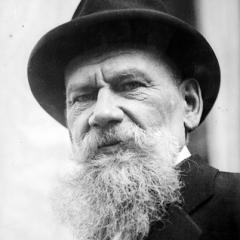
Leo Tolstoy
Leo Tolstoy

Leo Tolstoy was a Russian writer and thinker, a prominent representative of 19th-century Russian literature. His works deeply revealed social contradictions and human nature, and had a profound impact on the world. more

You May Also Like

“As a society, we assume that humans naturally run from emotions like suffering, helplessness, and hopelessness, but the truth is these emotions are highly addictive and far easier to indulge in (in a perversely satisfying way) than positive emotional subsets. Better yet, when you convince others of your helplessness, some people begin to regard you as a victim—someone to be adored and protected.”

“Everything that rises will fall. Empires, societies, governments. None of them lasts forever. Why? Because even though they are the products of change, they become resistant to change. The longer a society survives, the more it clings to its power, and the more it resists progress. The more it resists progress- resists change- the more its ciizens demand it. In response, the society tighten its grip, desperate to maintain control. It's afraid of losing its hold.”

“The "pathology of normalcy" rarely deteriorates to graver forms of mental illness because society produces the antidote against such deterioration. When pathological processes become socially patterned, they lose their individual character. On the contrary, the sick individual finds himself at home with all other similarly sick individuals. The whole culture is geared to this kind of pathology and arranged the means to give satisfactions which fit the pathology. The result is that the average individual does not experience the separateness and isolation the fully schizophrenic person feels. He feels at ease among those who suffer from the same deformation, in fact, it is the fully sane person who feels isolated in the insane society - and he may suffer so much from the incapacity to communicate that it is he who may become psychotic.”

“No other drug can compete with cannabis for its ability to satisfy the innate yearnings for Archaic boundary dissolution and yet leave intact the structures of ordinary society. If every alcoholic were a pothead, if every crack user were a pothead, if every smoker smoked only cannabis, the social consequences of the ‘drug problem’ would be transformed. Yet, as a society we are not ready to discuss the possibility of self-managed addictions and the possibility of intelligently choosing the plants we ally ourselves to. In time, and perhaps out of desperation, this will come.”