Quotessence
Home / Quotes / Quote by Swami Vivekananda

Quote by Swami Vivekananda

Work

The Complete Works of Swami Vivekananda - Eight-Volume Set

Browse quotes and source details for this work. more

Author
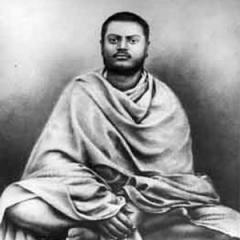
Swami Vivekananda
Swami Vivekananda

Swami Vivekananda (January 12, 1863 – July 4, 1902) was an Indian Hindu monk, philosopher, and social reformer. Born as Narendranath Datta in Kolkata, he was a chief disciple of the mystic Ramakrishna. He is best known for his historic speech at the 1893 Parliament of the World's Religions in Chicago, where he introduced Hinduism to the Western world. He founded the Ramakrishna Mission in 1897, focusing on social service, education, and interfaith harmony. His teachings emphasized self-realization, service to humanity, and the unity of all religions. He wrote extensively on yoga and Vedanta philosophy, influencing global spirituality and Indian nationalism. He died at the age of 39, leaving a lasting legacy as a bridge between Eastern and Western thought. more

You May Also Like

“Strebe nach diesem Kuss des Geliebten, dieser Berührung der Lippen, die den bhakta verzückt und ihn in Gott verwandelt. Für denjenigen, der mit einem solchen Kuss gesegnet wurde, verschwinden die Welten, Sonne und Mond vergehen und selbst das Universum schmilzt dahin in einen unendlichen Ozean der Liebe. Das ist die vollkommene Verzückung nondualer Liebe. (The Complete Works of Swami Vivekananda, Volume 3, Lectures from Colombo to Almora, The Sages of India) (S. 208)”

“(Nor was Shelley’s dad of any interest to Mira as an adversary. He was a mortgage broker with an irritable disposition who was always, in the family parlance, ‘in a rage’--an infirmity openly encouraged, as Mira pointed out, by his wife, who indeed devoted an unusual proportion of her daily conversation to reminding her husband of the many kinds of people in the world whom he disliked. That this list, which included vegans, slow walkers, loudmouths, ostentatious breast-feeders, people of indeterminate gender, buskers, bad drivers, and the unwashed, covered in one way or another the entire membership of Birnam Wood, Mira did not appear to find insulting. She saw Shelley’s father as a creature of his wife’s devising, not an autonomous adult, but a hapless pawn designed by Mrs Noakes for the solitary purpose of throwing her own, more vivid personality into greater relief--a plainly narcissistic exercise of which she, Mira, could not remotely see the appeal.)”

“When people are discussing as to what man and woman can do, always the same mistake is made. They think they show man at his best because he can fight, for instance, and undergo tremendous physical exertion, and this is pitted against the physical weakness and the non combating quality of woman. This is unjust. Woman is as courageous as man. Each is equally good in his or her way. What man can bring up a child with such patience, endurance, and love as the woman can? The one has developed the "power of doing"; the other, "the power of suffering". If a woman can't act, neither can man suffer. The whole universe is one of perfect balance. When you are judging man and woman, judge them by the standard of their respective greatness. One can't be in the other's shoes. Then one has no right to say that the other is wicked.”

“This mind is a part of the universal mind. Each mind is connected with every other mind. And each mind, wherever it is located, is in actual communication with the whole world. With preparations- not by chance thought transference work. A man wants to send a thought to another mind at a distance, and this other mind knows that a thought is coming, and he received it exactly as it is sent out. Distance makes no difference. But in the ordinary cases, it is not my thought that is reaching you direct; but my thought has got to be dissolved into ethereal vibrations and those ethereal vibrations go into your brain and they have to be resolved again into your own thoughts. This shows that there is a continuity of mind, as the yogis call it. The mind is universal. Your mind, my mind, all these little minds, are fragments of that universal mind, little waves in the ocean; and on account of this continuity, we can convey our thoughts directly to one another.”