Quotessence
Home / Quotes / Quote by Leo Tolstoy

Quote by Leo Tolstoy

“The military estate is the most honored. But what is war, what is needed for success in military affairs, what are the morals of military society? The aim of war is killing, the instruments of war are espionage, treason and the encouragement of it, the ruin of the inhabitants, robbing them or stealing to supply the army; deception and lying are called military stratagems; the morals of the military estate are absence of freedom, that is, discipline, idleness, ignorance, cruelty, depravity, and drunkenness. And in spite of that, it is the highest estate, respected by all . . . the one who has killed the most people gets the greatest reward . . . They come together . . . to kill each other, they slaughter and maim tens of thousands of men, and then they say prayers of thanksgiving for having slaughtered so many people . . . and proclaim victory, supposing that the more people slaughtered, the greater the merit. How does God look down and listen to them! . . . Ah, dear heart, lately it has become hard for me to live. I see that I've begun to understand too much. And it's not good for man to taste of the tree of the knowledge of good and evil . . . Well, it won't be for long!”

Quote by Leo Tolstoy

Author
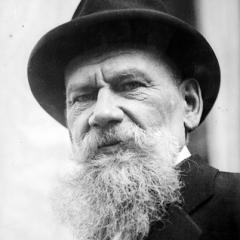
Leo Tolstoy
Leo Tolstoy

Leo Tolstoy was a Russian writer and thinker, a prominent representative of 19th-century Russian literature. His works deeply revealed social contradictions and human nature, and had a profound impact on the world. more

You May Also Like

“The Russian reader in old cultured Russia was certainly proud of Pushkin and of Gogol, but he was just as proud of Shakespeare or Dante, of Baudelaire or of Edgar Allan Poe, of Flaubert or of Homer, and this was the Russian reader's strength. I have a certain personal interest in the question, for if my fathers had not been good readers, I would hardly be here today, speaking of these matters in this tongue.”

“Then there were times when Vassy compulsively yet touchingly would get very drunk and break down in great heaving sobs when we got home. No one could possibly understand what it meant to be a 'fucking Russian in America,' he sobbed. 'My fucking country, my beloved Russia,' he would cry. 'No one understands my country. You judge us, you condemn us, you believe we have swords in our teeth. You're so conditioned, so brainwashed, even more than we are. At least Russians know about America, not only bad things. And you here imagine Russia as a concentration camp! You don't like Commies! That's your problem. Now I hear Americans think 'Russian' is the same as evil, stupidity, idleness. That's dangerous! What about our culture, our music, our ingenuity, our patience, endurance--these are qualities, not drawbacks! Yes, we are fucking different, why not? Why should we be the same? Instead of trying to change each other, why don't we simply tolerate our differences and enjoy similarities?”

“Умом Россию не понять, Аршином общим не измерить. У ней особенная стать, В Россию можно только верить! Fyodor Tyutchev, Russian poet, 1803–1873 You will not grasp her with your mind Or cover with a common label, For Russia is one of a kind — Believe in her, if you are able... translated by Anatoly Liberman, published in "Russian Life in the United States”

“En Union Soviétique, quand quelque chose ne va pas, dans un domaine d’activité quelconque, on pense d’abord structures. On l’a vu en août 1972, après le sévère réquisitoire du Comité Central du Parti contre la production cinématographique. Des mesures de réorganisation avaient tout de suite été prises. Un nouveau patron était nommé à la tête de Goskino. Deux mois plus tard, l’Union des Cinéastes se réunissait à Moscou. Un débat très libre s’ouvrait qui étonnait les correspondants étrangers par sa franchise. On y entendait Alexandre Medvedkine (Le Bonheur) s’interroger sur la notion de « film politique ». En même temps qu’étaient critiquées certaines mesures de réorganisation, on se félicitait de la création d’un « studio central des scénarios » susceptible d’assainir les rapports (difficiles, paraît-il) entre scénaristes et réalisateurs. Mais l’interrogation majeure de cette rencontre était : « Existe-t-il un cinéma pour les masses et un cinéma pour les élites ? ». On conviendra que c’était là une question d’importance. Surtout en Union Soviétique. Répondre oui c’était reconnaître l’existence possible de plusieurs publics avec ce que cela implique de conséquences sur la conception, la production, la distribution des films dans un appareil d’État qui fait volontiers du populisme une vertu.”

“I read many books on Russian artists, writers, philosophers, and musicians in an attempt to understand [Vassy, her partner]. I seemed to be concluding that the Russian himself was saying 'We are not to be understood.' It was maddeningly challenging to me. I didn't like not understanding...at least to my satisfaction. Half savage, half saint. That seemed to be the consensus of opinion among the Russians themselves. The communist government appeared to be irrelevant, merely a continuation in a different form of a system which basically denied the importance of the individual. Vassy had told me in the beginning that the Russian people had the government they needed and understood, and in many respects he even claimed they would want Joe Stalin back because he would, in effect, protect them from themselves.”

“That night at dinner, I thanked Rayya for taking care of everybody at the funeral, and for protecting us from the dangerous young man. She looked surprised, then her face softened. “Oh, honey,” she said, and suddenly tears stood in her eyes. “Did you think I was protecting us? No, baby, no. I was protecting him. Because here’s the reality, babe: We’re fine, and we’ll always be fine—even if he stole our car! Nobody needs to worry about us. But the odds are that kid doesn’t have much longer to live. He’s really far gone, and he doesn’t have any support system. But there’s always a chance he might get clean some day, with a miracle. And if he ever cleans up his life, as part of his recovery he’ll have to make amends to every single person he’s ever harmed. And I don’t want that poor kid, in addition to everything else he’ll have to face someday, to be forced to deal with the fact that he stole money from people at his grandmother’s funeral. I wouldn’t want that for anybody. So that’s what we were doing today, honey. We were keeping him safe from that—from the worst thing he could do to himself.”

“Ex-Foreign Legionnaires in London, for instance, often use the same pubs, but more than that they all know where to contact each other if ever they’re threatened. If they’re ever in trouble - and by nature of the life they’ve led that’s highly probable - members of their tribe will immediately come from all over London to lend robust assistance. There are similar tribes in the underbelly of every city. I just happen to know about ex-Legionnaires because I’ve come across a couple, drank with them and listened to their stories. It’s like sitting with pirates, fortune-hunters, bank robbers and Gypsies”