Quotessence
Home / Quotes / Quote by Carl Sagan

Quote by Carl Sagan

“But if the Bible is not everywhere literally true, which parts are divinely inspired and which are merely fallible and human? As soon as we admit that there are scriptural mistakes (or concessions to the ignorance of the times), then how can the Bible be an inerrant guide to ethics and morals?”

Quote by Carl Sagan

Work

Pale Blue Dot: A Vision of the Human Future in Space

This book delves into the possibilities of human expansion into space, reflecting on the implications and significance of our existence in the vastness of the universe. more

Author
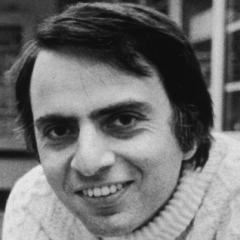
Carl Sagan
Carl Sagan

Carl Sagan was an American astronomer, cosmologist, author, and science communicator, born on November 9, 1934, in Brooklyn, New York. He is renowned for his profound research into the cosmos and his dedication to popularizing science. Sagan proposed numerous theories about the origin of the universe and life, and he made complex scientific knowledge accessible to the public with his unique perspective and clear, engaging writing style. more

You May Also Like

“Somewhere along the way we've lost our convictions, and it appears that in the losing we've altogether forgotten what convictions are. For convictions have been meticulously redefined as rights run amuck in the service of self, greed mongering goals touted as the call of destiny obediently obeyed, the desire to abide by tawdry trends so as not to be ousted by favored groups, and other such horribly debilitating vices. And despite this utterly absurd rewrite (which is in fact a careless editing incessantly pawned off as embracing the most riveting legitimacy imaginable), convictions are in fact the commitment to steadfastly adhere to sound principles and proven ethics that thoughtfully build the world around us as they reshape the ugly agendas within us.”

“Do not tell me about your principles, for words are easy to craft and talk is cheap. Rather, let me see you live them out in the sentence and syntax of everyday life. And let me see that not so that I know that you understand the principles that you espouse, for that is easy. Rather, I want to know that you understand the sacrifice of living them out, and that the weight of the principle offsets the sacrifice of carrying it.”

“Everybody works according to his ability, some doing more, some doing less, but everyone ought to know whether he is doing good or harm. Artists are not released from that obligation, especially as there are no works of art which do neither harm nor good. If a book, a picture or a melody is accepted by a reader, a spectator or a listener, it means that the reader, spectator or listener has had his emotions stirred; and emotions must be either harmful or useful. They cannot be neutral.”

“... and I realise the only way to tell the others is through the way my voice can take these broken words and turn it into music. Turn it into poetry. And I sing to make myself come alive, but also for you, because I’d like this to mean something. To not disappear with the dark I will enter one day and so now I will tell. If not for you, then for my own heart, because it tells me to, and I'm learning to listen.”