Quotessence
Home / Quotes / Quote by Thomas Aquinas

Quote by Thomas Aquinas

“*There is only one God*. Whatever exists is *ipso facto* individual; to be one it needs no extra property and calling it one merely denies that it is divided. Simple things are neither divided nor divisible; composite things do not exist when their parts are divided. So existence stands or falls with individuality, and things guard their unity as they do their existence. But what is simply speaking one can yet in certain respects be many: an individual thing, essentially undivided, can have many non-essential properties; and a single whole, actually undivided, can have potentially many parts. Only when one is used to count with does it presuppose in what it counts some extra property over and above existence, namely, quantity. The one we count with contrasts with the many it counts in the way a unity of measurement contrasts with what it measures; but the individual unity common to everything that exists contrasts with plurality simply by lacking it, as undividedness does division. A plurality is however *a* plurality: though simply speaking many, inasmuch as it exists, it is, incidentally, one. A continuum is homogeneous: its parts share the form of the whole (every bit of water is water); but a plurality is heterogeneous: its parts lack the form of the whole (no part of the house is a house). The parts of a plurality are unities and non-plural, though they compose the plurality not as non-plural but as existing; just as the parts of a house compose the house as material, not as not houses. Whereas we define plurality in terms of unity (many things are divided things to each of which is ascribed unity), we define unity in terms of division. For division precedes unity in our minds even if it doesn’t really do so, since we conceive simple things by denying compositeness of them, defining a point, for example, as lacking dimension. Division arises in the mind simply by negating existence. So the first thing we conceive is the existent, then―seeing that this existent is not that existent―we conceive division, thirdly unity, and fourthly plurality. There is only one God. Firstly, God and his nature are identical: to be God is to be this individual God. In the same way, if to be a man was to be Socrates there would only be one man, just as there was only one Socrates. Moreover, God’s perfection is unlimited, so what could differentiate one God from another? Any extra perfection in one would be lacking in the other and that would make him imperfect. And finally, the world is one, and plurality can only produce unity incidentally insofar as it too is somehow one: the primary and non-incidental source of unity in the universe must himself be one. The one we count with measures only material things, not God: like all objects of mathematics, though defined without reference to matter, it can exist only in matter. But the unity of individuality common to everything that exists is a metaphysical property applying both to non-material things and to God. But what in God is a perfection has to be conceived by us, with our way of understanding things, as a lack: that is why we talk of God as lacking a body, lacking limits and lacking division.”

Quote by Thomas Aquinas

Work

Summa Theologiae: A Concise Translation

Browse quotes and source details for this work. more

Author
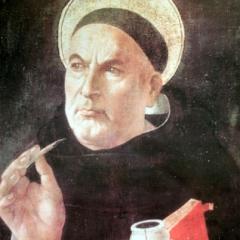
Thomas Aquinas
Thomas Aquinas

Thomas Aquinas, born on January 28, 1225 and died on March 7, 1274, was a renowned theologian, philosopher, and priest. He is considered one of the greatest theologians of the Middle Ages and his works have had a profound impact on philosophy and theology. more

You May Also Like

“It will be seen how there can be the idea of a special science, the *critique of pure reason* as it may be called. For reason is the faculty which supplies the *principles* of *a priori* knowledge. Pure reason therefore is that which contains the principles of knowing something entirely *a priori*. An *organon* of pure reason would be the sum total of the principles by which all pure *a priori* knowledge can be acquired and actually established. Exhaustive application of such an organon would give us a system of pure reason. But as this would be a difficult task, and as at present it is still doubtful whether indeed an expansion of our knowledge is possible here at all, we may regard a science that merely judges pure reason, its sources and limits, as the *propaedeutic* to the system of pure reason. In general, it would have to be called only a *critique*, not a *doctrine* of pure reason. Its utility, in regard to speculation, would only be negative, for it would serve only to purge rather than to expand our reason, and, which after all is a considerable gain, would guard reason against errors. I call all knowledge *transcendental* which deals not so much with objects as with our manner of knowing objects insofar as this manner is to be possible *a priori*. A system of such concepts would be called *transcendental philosophy*. But this is still, as a beginning, too great an undertaking. For since such a science must contain completely both analytic and synthetic *a priori* knowledge, it is, as far as our present purpose is concerned, much too comprehensive. We will be satisfied to carry the analysis only so far as is indispensably necessary in order to understand in their whole range the principles of *a priori* synthesis, with which alone we are concerned. This investigation, which properly speaking should be called only a transcendental critique but not a doctrine, is all we are dealing with at present. It is not meant to expand our knowledge but only to correct it, and to become the touchstone of the value, or lack of value, of all *a priori* knowledge. Such a critique is therefore the preparation, as far as possible, for a new organon, or, if this should turn out not to be possible, for a canon at least, according to which, thereafter, the complete system of a philosophy of pure reason, whether it serve as an expansion or merely as a limitation of its knowledge, may be carried out both analytically and synthetically. That such a system is possible, indeed that it need not be so comprehensive as to cut us off from the hope of completing it, may already be gathered from the fact that it would have to deal not with the nature of things, which is inexhaustible, but with the understanding which makes judgments about the nature of things, and with this understanding again only as far as its *a priori* knowledge is concerned. The supply of this *a priori* knowledge cannot be hidden from us, as we need not look for it outside the understanding, and we may suppose this supply to prove sufficiently small for us to record completely, judge as to its value or lack of value and appraise correctly. Still less ought we to expect here a critique of books and systems of pure reason, but only the critique of the faculty of pure reason itself. Only once we are in possession of this critique do we have a reliable touchstone for estimating the philosophical value of old and new works on this subject. Otherwise, an unqualified historian and judge does nothing but pass judgments upon the groundless assertions of others by means of his own, which are equally groundless.”

“What is gained by the transcendence of the object is the identifiability of the object in a plurality of acts and the identifiability of what is thought by several individuals. This identifiability is not restricted to ideal objects, which are generated according to a definite operational law and are therefore producible by everyone out of the same material of intuition which is given prior to any particular sense-experience. The identifiability obtains in precisely the same way for objects of myth and folklore, of belief and artistic fantasy. Goethe’s Faust, Apollo, and Little Red Riding Hood can be identified by several individuals and are the objects of common, universally valid statements. Indeed, exact identity of the nature of the object in question and evidential knowledge of this identity can occur *only* in the case of ideal objects. Our certainty that we all think the same number 3 in the strictest identity of its nature is much more evident than that we all think the same real object, a tree, for instance. In the case of real objects we can actually prove that it is impossible for the momentary content in which the object is represented and thought to be exactly the same in a plurality of acts and for many individuals. The only other contribution made by the fact of the consciousness of transcendence, so long overlooked in recent philosophy, to the problem of reality is this: the acts in which this consciousness is present can bring the givenness of reality, of which we shall speak later, into “objective” form, and can therefore elevate that which is given in this way as real to the status of a real “object.” But with this, the contribution of the consciousness of transcendence to the problem of reality is at an end. Although N. Hartmann made the same point with respect to Paul Linke’s otherwise shrewd and pertinent comments on his doctrine of reality, still we should emphasize that the transcendence of the object does not *exclude* the reality of the object, not even of the *same* object in the strict sense of “same.” ―from_Idealism and Realism_”

“It is very important to note that the transcendence of the object is by no means a primitive component necessarily ingredient in all knowledge. It is missing in all ecstatic knowledge. In ecstatic knowledge the known world is still not objectively given. Only when the (logically and genetically simultaneous) act furnishing ecstatic knowledge and the subject which performs this act become themselves the content of knowledge in the act of reflection does the character originally given in ecstatic knowledge become a mere reference pointing to the “object.” It is only here that the object or that which turns into an object remains from now on “transcendent” to consciousness. Therefore, whenever there is consciousness, objects transcendent to consciousness must also be given to consciousness. Their structural relationship is indissoluble. Whenever self-consciousness and consciousness of an object arise, they do so simultaneously and through the same process. The categorical form of an object is not first impressed in a judgment upon a nonobjective given, not even in a one-term, simple judgment, as some people have thought (e.g., Heinrich Maier in his book *Wahrheit und Wirklichkeit*). This is a pure construction. Consciousness of an object precedes all judgment and is not originally constituted by judgment. The same holds true of consciousness of states of affairs. The consciousness of an object and the intentional object are not the result of an active [tätige] “forming” or “imprinting” which we perform on the given through judgments or any other operations of thought. On the contrary, they are the result of a pulling back, the result, that is, of the re-flexive act, in which an originally ecstatic [*ekstatisch gebender*] act turns back knowingly onto itself and comes upon a central self as its starting point. This central self can be given at every level and degree of “concentration” and “collectedness” in “self-consciousness.” What we had hold of [*das Gehabte*] remains “as” object, while the act of reflection turns the knowing back into the knower, as the result of a turning away [*Abwendung*] and a pulling back, and not of an active turning to [*Zuwendung*]. From what has been said, one may very well imagine that the real world could be abolished without consciousness and the self being altered or abolished thereby. But this could in no way be the case with the world of objects that transcend consciousness. Descartes as well as Lotze misunderstood this. Where a *cogito* exists, there must also be a *cogitatur* in which a transcendent object is thought. Only a being capable of reflection (*reflexio*) and self-consciousness *can* have objects. Charlotte Bühler has recently made it seem probable that the infant does not yet possess objective consciousness. In waking from the effects of a drug we can follow the process by which the givenness of the surrounding world becomes objective again. There is one last point of contact between the problem of reality and the consciousness of transcendence. The consciousness of transcendence, as already indicated, shows how the mere ecstatic possession of reality on the level of the immediately experienced resistance of an X to the central drives of life passes over into a reflexive and thus objective possession of reality. And we find similar transitions between ecstatic remembering which is merged in the being of what is past and reflexive remembering, between ecstatic drive activities and recurrent deliberation [*Besinnung*], between ecstatic surrender to a value and objectification of a value, between identifying with an alter ego and “understanding” [*Verstehen*] another, however slightly.” ―from_Idealism and Realism_”

“The third preliminary problem for every theory of reality is that of the experience of transcendence. We saw in the case of Berkeley that his erroneous principle *percipi est esse*, and his assertion that any being which we think, just for the reason that it is thought, cannot at the same time be regarded as subsisting independently of thinking, incorporate a failure to recognize the consciousness of transcendence peculiar to all intentional acts. This is an instance of the failure to recognize that not only all thinking in the narrower sense, in the sense of grasping an object on the basis of “meanings” and grasping a state of affairs through judgments, but *every* intention in general, whether perception, representation, remembering, the feeling of value, or the posing of ends and goals, points beyond the act and the contents of the act and intends something other than the act [*ein Aktfremdes*], even when what is thought is in turn itself a thought. Indeed, *intentio* signifies a goal-directed movement toward something which one does not have oneself or has only partially and incompletely. Berkeley (following Locke, who was the first to make the basic philosophical error which introduced “psychologism” into epistemology) arrived at the principle *esse est percipi* by making the idea [*Vorstellung*] (and even the sensation) into a thing, an immaterial substance, and by failing to distinguish between the act, the content of an act, and the object. Furthermore, Berkeley confused the being of objects with the fact of being-an-object, even though the latter has only a loose and variable connection with the former. On the other hand, the transcendence of the intentional object with respect to both the *intentio* and its present content is common to every instance of being-an-object. It is, for instance, proper to objects of pure mathematics which are certainly not real but ideal (for example, the number 3). These are produced from the *a priori* material of intuition in accordance with an operational law governing the steps of our thought or intuition. Transcendence is further proper to all fictitious objects and even to contradictory objects, for instance, a square circle. All these sorts of objects, e.g., the golden mountain or Little Red Riding Hood, satisfy the basic principle of the transcendence of objects over and above that aspect of them which is, at any moment, given in consciousness, just as much as do real objects existing independently of all consciousness and knowledge." ―from_Idealism and Realism_”

“It is precisely because the principle of the transcendence of the object is completely independent of the existential status of the objects themselves and, thus, independent of the question whether they are produced by us or subsist on their own―whether they are fictions or real beings―that the fact of the consciousness of transcendence is not even remotely qualified to solve the problem of reality. This has been misunderstood equally by W. Freytag, Edith Landmann, P. Linke, and even by Husserl himself. Indeed, people have wanted to speak of an intentional realism (E. Landmann) in contrast to Critical Realism and to all other forms of realism. N. Hartmann was quite correct in emphasizing, in opposition to this, that the projection [*Hinausragen*] of the intentional object beyond the content of consciousness and its act cannot make the least contribution to solving the problem of realism. If something is an intentional object, we cannot recognize from this fact alone, whether it is real or not. If the perceived cherry, the conceived triangle, a friend’s visit anticipated in a dream, Little Red Riding Hood, a freely planned project, or a felt value, have entirely different characteristics and predicates than do the mental processes and the actual contents in which these objects appear, then the distinction between intentional and mental holds equally of both the real and the irreal. *Thus, the problem of what is real is not touched by the fact of the transcendence of the object*, and *percipi est esse*, in Berkeley’s psychologistic sense, is laid to rest. This also frustrates attempts, such as Hume’s in his *Treatise*, to derive being-an-object in general―an object as distinguished from an idea―from a psychogenetic process in which the very ideas through which this psychogenetic process is supposed to be accomplished are themselves reified [*verdinglicht*]." ―from_Idealism and Realism_”

“Just like the forces of Good and Evil, on the levels so much distant from man, logic and reason clash with each other. In that merciless, multi-millennial and primal battle, none of them stepped away for an inch. In a craddle, like no man's land, we, the young human beings, find ourselves gazing upon the "toys that glitter". I wanted to believe.”