Quotessence
Home / Quotes / Quote by Mikhail Bakunin

Quote by Mikhail Bakunin

“I am a convinced advocate of economic and social equality because I know that, without it, liberty, justice, human dignity, morality, and the well-being of individuals, as well as the prosperity of nations, will never amount to more than a pack of lies. But since I stand for liberty as the primary condition of mankind, I believe that equality must be established in the world by the spontaneous organization of labor and the collective ownership of property by freely organized producers' associations, and by the equally spontaneous federation of communes, to replace the domineering paternalistic State.”

Quote by Mikhail Bakunin

Author
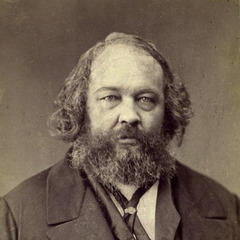
Mikhail Bakunin
Mikhail Bakunin

Mikhail Bakunin, born on May 30, 1814, and died on July 1, 1876, was a significant thinker and revolutionary from Russia. His ideas had a profound impact on the later anarcho-syndicalist movement. more

You May Also Like

“By contrast, the traditional revolutionary demand for council forms of organization (what Hannah Arendt describes as "the revolutionary heritage") does not break completely with the terrain of hierarchical society. Workers' councils originate as class councils. Unless one assumes that workers are driven by their interests as workers to revolutionary measures against hierarchical society (an assumption I flatly deny), then these councils can be used just as much to perpetuate class society as to destroy it. We shall see, in fact, that the council form contains many structural limitations which favor the development of hierarchy. For the present, it suffices to say that most advocates of workers' councils tend to conceive of people primarily as economic entities, either as workers or nonworkers. This conception leaves the onesidedness of the self completely intact. Man is viewed as a bifurcated being, the product of a social development that divides man from man and each man from himself. Nor is this one-sided view completely corrected by demands for workers' management of production and the shortening of the work week, for these demands leave the nature of the work process and the quality of the worker's free time completely untouched. If workers' councils and workers' management of production do not transform the work into a joyful activity, free time into a marvelous experience, and the workplace into a community, then they remain merely formal structures, in fact, class structures. They perpetuate the limitations of the proletariat as a product of bourgeois social conditions. Indeed, no movement that raises the demand for workers' councils can be regarded as revolutionary unless it tries to promote sweeping transformations in the environment of the work place.”

“The anarchists cannot consider, like the collectivists, that a remuneration which would be proportionate to the hours of labour spent by each person in the production of riches may be an ideal, or even an approach to an ideal, society. Without entering here into a discussion as to how far the exchange value of each merchandise is really measured now by the amount of labour necessary for its production—a separate study must be devoted to the subject—we must say that the collectivist ideal seems to us merely unrealizable in a society which has been brought to consider the necessaries for production as a common property. Such a society would be compelled to abandon the wage-system altogether. It appears impossible that the mitigated individualism of the collectivist school could co-exist with the partial communism implied by holding land and machinery in common—unless imposed by a powerful government, much more powerful than all those of our own times. The present wage-system has grown up from the appropriation of the necessaries for production by the few; it was a necessary condition for the growth of the present capitalist production; and it cannot outlive it, even if an attempt be made to pay to the worker the full value of his produce, and hours-of-labour-checks be substituted for money. Common possession of the necessaries for production implies the common enjoyment of the fruits of the common production; and we consider that an equitable organization of society can only arise when every wage-system is abandoned, and when everybody, contributing for the common well-being to the full extent of his capacities, shall enjoy also from the common stock of society to the fullest possible extent of his needs.”

“As far as socialism, I used to think I was fundamentally opposed to it, but eventually came to realize that wasn't really true, and that what I actually oppose is aggression. Voluntary socialism can be a wonderful way of living for small groups, and most people practice some form of it in their families. Only when imposed on people by force does socialism become evil. One of the beautiful things about a libertarian society is that people could still create socialist communes and be left alone to redistribute resources within them to their hearts' content, so long as no one is forced to join or prevented from leaving. This stands in stark contrast to a state-socialist society, which cannot similarly tolerate peaceful acts of capitalism among consenting participants.”

“A good example of a really large-scale anarchist revolution—in fact the best example to my knowledge—is the Spanish revolution in 1936, in which over most of Republican Spain there was a quite inspiring anarchist revolution that involved both industry and agriculture over substantial areas, developed in a way which to the outside looks spontaneous. Though in fact if you look at the roots of it, you discover that it was based on some three generations of experiment and thought and work which extended anarchist ideas to very large parts of the population in this largely pre-industrial—though not totally pre-industrial—society. And that again was, by both human measures and indeed anyone's economic measures, quite successful. That is, production continued effectively; workers in farms and factories proved quite capable of managing their affairs without coercion from above, contrary to what lots of socialists, communists, liberals and others wanted to believe, and in fact you can't tell what would have happened. That anarchist revolution was simply destroyed by force, but during the period in which it was alive I think it was a highly successful and, as I say, in many ways a very inspiring testimony to the ability of poor working people to organize and manage their own affairs, extremely successfully, without coercion and control. How relevant the Spanish experience is to an advanced industrial society. one might question in detail.”

“Man: Don't these precedents suggest that there is something inherently pre-industrial about the applicability of libertarian ideas—that they necessarily presuppose a rather rural society in which technology and production are fairly simple, and in which the economic organization tends to be small-scale and localized? Well, let me separate that into two questions: one, how anarchists have felt about it, and two, what I think is the case. As far as anarchist reactions are concerned, there are two. There has been one anarchist tradition—and one might think, say, of Kropotkin as a representative—which had much of the character you describe. On the other hand there's another anarchist tradition that develops into anarcho-syndicalism which simply regarded anarchist ideas as the proper mode of organization for a highly complex advanced industrial society. And that tendency in anarchism merges, or at least inter-relates very closely with a variety of left-wing Marxism, the kind that one finds in, say, the Council Communists that grew up in the Luxemburgian tradition, and that is later represented by Marxist theorists like Anton Pannekoek, who developed a whole theory of workers' councils in industry and who is himself a scientist and astronomer, very much part of the industrial world. So which of these two views is correct? I mean, is it necessary that anarchist concepts belong to the pre-industrial phase of human society, or is anarchism the rational mode of organization for a highly advanced industrial society? Well, I myself believe the latter, that is, I think that industrialization and the advance of technology raise possibilities for self-management over a broad scale that simply didn't exist in an earlier period. And that in fact this is precisely the rational mode for an advanced and complex industrial society, one in which workers can very well become masters of their own immediate affairs, that is, in direction and control of the shop, but also can be in a position to make the major substantive decisions concerning the structure of the economy, concerning social institutions, concerning planning regionally and beyond. At present, institutions do not permit them to have control over the requisite information, and the relevant training to understand these matters. A good deal could be automated. Much of the necessary work that is required to keep a decent level of social life going can be consigned to machines—at least in principle—which means humans can be free to undertake the kind of creative work which may not have been possible, objectively, in the early stages of the industrial revolution.”

“Question: A number of people have noted that you use the term "libertarian socialist" in the same context as you use the word ''anarchism." Do you see these terms as essentially similar? Is anarchism a type of socialism to you? The description has been used before that anarchism is equivalent to socialism with freedom. Would you agree with this basic equation? The introduction to Guerin's book that you mentioned opens with a quote from an anarchist sympathizer a century ago, who says that "anarchism has a broad back," and "endures anything." One major element has been what has traditionally been called "libertarian socialism." I've tried to explain there and elsewhere what I mean by that, stressing that it's hardly original; I'm taking the ideas from leading figures in the anarchist movement whom I quote, and who rather consistently describe themselves as socialists, while harshly condemning the "new class" of radical intellectuals who seek to attain state power in the course of popular struggle and to become the vicious "red bureaucracy" of which Bakunin warned; what's often called "socialism." I rather agree with Rudolf Rocker's perception that these (quite central) tendencies in anarchism draw from the best of Enlightenment and classical liberal thought, well beyond what he described. In fact, as I've tried to show they contrast sharply with Marxist-Leninist doctrine and practice, the "libertarian" doctrines that are fashionable in the U.S. and UK particularly, and other contemporary ideologies, all of which seem to me to reduce to advocacy of one or another form of illegitimate authority, quite often real tyranny.”

“Question: It's a great book and its obvious that Guerin was very keen to blend what he felt were the best aspects of anarchism and the best aspects of socialism into this Libertarian Socialism. Do you think that those two terms Libertarian Socialism and Anarchism—are synonymous or do you think there are real differences between the two? Well, I don't think we can really say, because the terms of political discourse aren't well defined. Capitalism, trade, the state, pick any one... they are pretty loose terms. Which is okay, but it doesn't make sense to try to define these terms carefully when you don't have an explanatory theory to embed them in. But the fact is we can't really answer the question, anarchism covers too many things, libertarian socialism covers too many things. But I sympathize with what he's trying to do. I think it's the right thing. If you look carefully they are really close, there are similarities and relationships. The more anti-statist, antivanguardist left elements of the socialist movement, Marxist movement in fact—folks like Anton Pannekoek and others—there are close similarities between them and some of the wings of the anarchist movement, like the anarcho-syndicalists. It's pretty hard to make much of a distinction between, say, Pannekoek's workers' councils and anarcho-syndicalist conceptions of how to organize society. There are some differences, but they are the kind of differences that ought to exist when people are working together in comradely relationships. So, yes, that's a sensible blend in my view. The much sharper distinction is between all these movements and the various forms of totalitarianism like Bolshevism, corporate capitalism and so on. There you have a real break. Totalitarian structures on the one hand and free societies on the other. In fact, 1 think there are significant similarities between libertarian socialism and anarchism, this blend, and even very mainstream thinkers like John Dewey—there are striking similarities.”