Quotessence
Home / Quotes / Quote by Elizabeth Cady Stanton

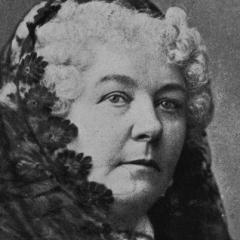
Quote by Elizabeth Cady Stanton

“Whatever the theories may be of woman’s dependence on man, in the supreme moments of her life he can not bear her burdens. Alone she goes to the gates of death to give life to every man that is born into the world. No one can share her fears, no one can mitigate her pangs; and if her sorrow is greater than she can bear, alone she passes beyond the gates into the vast unknown.”

Quote by Elizabeth Cady Stanton

Work

Solitude of Self

Browse quotes and source details for this work. more

Author

Elizabeth Cady Stanton

Elizabeth Cady Stanton, born on November 12, 1815, and died on October 26, 1902, was a pioneering American activist for women's rights. She was a key figure in the women's rights movement, known for her dedication to the fight for women's suffrage and gender equality. more

You May Also Like

“The path to the ethnic democratization of American society is through its culture, that is to say through its cultural apparatus, which comprises the eyes, the ears, and the "mind" of capitalism and is twentieth-century voice to the world. Thus to democratize the cultural apparatus is tantamount to revolutionizing American society itself into the living realization of its professed ideas. Seeing the problem in another way, to revolutionize the cultural apparatus is to deal fundamentally with the unsolved American question of nationality--Which group speaks for America and for the glorification of which ethnic image? Either all group images speak for themselves and for the nation, or American nationality will never be determined.”

“In America, the materio-economic conditions relate to a societal, multi-group existence in a way never before know in world history. American Negro nationalism can never create its own values, find its revolutionary significance, define its political and economic goals, until Negro intellectuals take up the cudgels against the cultural imperialism practiced in all of its manifold ramifications on the Negro within American culture. But this kind of revolution would have to be predicated on the recognition that the cultural and artistic originality of the American nation is founded, historically, on the ingredients of a black aesthetic and artistic base.”