Quotessence
Home / Quotes / Quote by Stefan Zweig

Quote by Stefan Zweig

“For the first time I began to perceive that true sympathy cannot be switched on and off like an electric current, that anyone that identifies himself with the fate of another is robbed to some extent of his own freedom.”

Quote by Stefan Zweig

Work

Beware of Pity

Browse quotes and source details for this work. more
Author

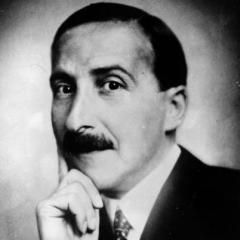
Stefan Zweig
Stefan Zweig

Stefan Zweig, born on November 28, 1881 in Vienna, was an Austrian novelist, playwright, and biographer. Known for his profound psychological insights and unique narrative style, he is a significant figure in European literature at the beginning of the 20th century. more

You May Also Like

“[People] ask themselves, what is suitable for my position? What is usually done by persons of my station and percuniary circumstances? Or (worse still) what is usually done by persons of a station and circumstances superior to mine? I do not mean that they choose what is customary in preference to what suits their own inclinations. It does not occur to them to have any inclination, except for what is customary. Thus the mind itself is bowed to the yoke: even in what people do for pleasure, conformity is the first thing thought of; they like in crowds; they exercise choice only among things that are commonly done: peculiarity of taste, eccentricity of conduct, are shunned equally with crimes: until by dint of not following their own nature they have no nature to follow: their human capacities are withered and starved: they become incapable of any strong wishes or native pleasures, and are generally without either opinions or feelings of home growth, or properly their own.”

“There is another more psychological obstacle to the full development of love in the modern world, and that is the fear that many people feel of not preserving their individuality in tact. This is a foolish and rather modern terror. Individuality is not an end in itself; it is something that must enter into fructifying contact with the world, and in so doing must lose its separateness. An individuality which is kept in a glass case withers, whereas on e that is freely expended in human contacts becomes enriched.”

“We each have our own language. Our own way of thinking, of talking to ourselves, of making sense of the world and putting it in order. A narration style that is ours and ours alone. That's why some of us connect and some of us don't. Because even though we can only live in our own heads, sometimes - every now and then - we meet a person we can talk to without speaking at all: whose story we can read, without even trying.”

“I knew what I stood for, even if nobody else did. I knew the piece of me on the inside, truer than all the rest, that never comes out. Doesn't everyone have one? Some kind of grand inner princess waiting to toss her hair down, forever waiting at the tower window. Some jungle animal so noble and fierce you had to crawl on your belly through dangerous grasses to get a glimpse.”