Quotessence
Home / Quotes / Quote by Bertrand Russell

Quote by Bertrand Russell

“There is another more psychological obstacle to the full development of love in the modern world, and that is the fear that many people feel of not preserving their individuality in tact. This is a foolish and rather modern terror. Individuality is not an end in itself; it is something that must enter into fructifying contact with the world, and in so doing must lose its separateness. An individuality which is kept in a glass case withers, whereas on e that is freely expended in human contacts becomes enriched.”

Quote by Bertrand Russell

Work

Marriage and Morals

This book delves into the philosophical underpinnings of marriage, examining its moral dimensions and societal impact. more

Author

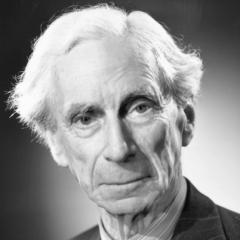
Bertrand Russell
Bertrand Russell

Bertrand Russell was a British philosopher, mathematician, and logician born on May 18, 1872, and died on February 2, 1970. He is known for his contributions to logic and mathematics, particularly in the fields of mathematical logic and philosophical analysis. His works spanned a wide range of subjects, including ethics, political philosophy, history, and literary criticism. more

You May Also Like

“We each have our own language. Our own way of thinking, of talking to ourselves, of making sense of the world and putting it in order. A narration style that is ours and ours alone. That's why some of us connect and some of us don't. Because even though we can only live in our own heads, sometimes - every now and then - we meet a person we can talk to without speaking at all: whose story we can read, without even trying.”

“I knew what I stood for, even if nobody else did. I knew the piece of me on the inside, truer than all the rest, that never comes out. Doesn't everyone have one? Some kind of grand inner princess waiting to toss her hair down, forever waiting at the tower window. Some jungle animal so noble and fierce you had to crawl on your belly through dangerous grasses to get a glimpse.”

“Much like humans, opinions come in all shapes and forms, but in the end, they are just what they are; and may yet still be categorized in nature. The first you might say is the Indoctrinal, which is, of course, dictated by community and necessity, by the human need for acceptance; secondly, there is the Personal, and this is often dictated by individuality, by the yearning to seem interesting and intelligent, or free, or special; and lastly comes the Emotional. This is most commonly dictated by circumstance and bitterness and excitement. However, rarely do we find the case in which any of these are dictated by reason in the pure state: it is by this we see that at the core of a number of false opinions lies not always misinformation but quite often some issue of the human self.”