Quotessence
Home / Quotes / Quote by John Milton

Quote by John Milton

“This further consolation yet secure I carry hence; though all by mee is lost, Such favour I unworthie am voutsaft, By mee the Promis'd Seed shall all restore.”

Quote by John Milton

Author
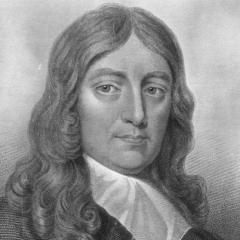
John Milton
John Milton

John Milton, born on December 9, 1608, in London, and died on November 8, 1674, was a renowned English poet and scholar. He is best known for his epic poem 'Paradise Lost,' which has had a profound impact on world literature. more

You May Also Like

“For him, England has always been a land of fairy tales: a world of pictures, of black-and-white sketches depicting pale, chubby children eating currant buns. A land of fairies and witches, hedgerows and secret gardens, goblins and magical woods. When he arrived he was surprised to find it looked almost exactly as it did in the stories. The trees, the meadows, the little brick houses. He had not come to a real country, but a story come to life. Every day, then, he woke to a fantasy. And no matter how solid and cold and uncomfortable it was, he could never feel it was a country as such, could never quite believe that it had been formed from the same molten stuff that had made his birthplace. England was always secondary, always derivative, always an aftereffect of a story. Perhaps this is why, now, he can decide to leave it.”

“Through the archway, and up the hill, I feel it surging, and drop to my knees. A string of black smoke wafts out of my mouth, as a long slender form starts to crawl out of my gaping maw. My eyes water as it slides and pulls and slowly works its way out of me, trying not to bite down, struggling to breathe. And in the glow of the moon the serpent finally weaves its muscled form out of me, a diamond pattern running down its length, crisscrossed threads of silver, a flicker of its tongue, and an angry hiss permeating the night. As it slithers into the underbrush—ten feet, twenty feet, thirty feet long—the last of it to disappear are three razor sharp needles sticking out of its tail. (End of Chapter Two.)”

“Somehow, a pervasive idea has spread in modern times that the mom who is out and about soonest with her baby is somehow the strongest, like an episode of Survivor. For some type-A parents, it's almost a badge of honor to say you made it to yoga after two weeks, snuck off to the office for a meeting, or flew with your infant across time zones. But that's all upside down—in a healthy postpartum period, it's she who stays still that wins the prize.”

“At first there was only light and sound. Bright, dazzling yellow that shone through the formless void of darkness and a cacophony of tuneless, unintelligible noise that frightened and confused her. The warmth of the sun was heavy and strong, and it burned. A sudden, brisk breeze cut through it, and her whole little body shivered. She curled into a ball. The noises were deep and resonant. There was thudding on the ground all around her and long, consistent growls from every direction. She opened her eyes and in the blur of yellow she began to see the great, blue sheet above and the endless, dusty ground below. Shadows loomed around her. Gigantic forms that blocked out the light and the heat. They reached out toward her, touched her. Finally, the sensory overload became too much. The bolts of panic shooting through her quivering flesh took hold. She raised her trunk into the air and screamed out…”

“The English word anxiety comes from a Latin root which means narrowing down, and in the beginning the word was used for the entry of a soul into a womb. So the first anxiety is felt when a soul enters a womb, because everything is narrowed down; an infinite soul becomes a small body. This is the most painful process possible, as if the whole sky has been forced to enter into a seed. You don't know it because it is so painful that you become totally unconscious. There are two painful processes. You may have heard Buddha's saying, "Birth is pain, death is pain." These are the greatest pains, the greatest anguishes possible. When the infinite becomes finite in the womb, it is painful, it is anxiety; and when the infinite is taken out of the body again there is anguish and pain. So whenever someone dies consciously, he disappears. Then there is no more entry into the body. Then there is no more anxiety, because anxiety is the consequence of desire; then you need not be narrowed down because there is no desire to be fulfilled. You can remain infinite; there is no need to enter a vehicle because now you are going nowhere.”