Quotessence
Home / Quotes / Quote by Robert E. Lee

Quote by Robert E. Lee

“The march of Providence is so slow and our desires so impatient; the work of progress so immense and our means of aiding it so feeble; the life of humanity is so long, that of the individual so brief, that we often see only the ebb of the advancing wave and are thus discouraged. It is history that teaches us to hope.”

Quote by Robert E. Lee

Author
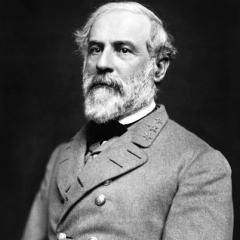
Robert E. Lee
Robert E. Lee

Robert E. Lee, a prominent military officer in American history, was born on January 19, 1807, and died on October 12, 1870. He served as the commanding general of the Confederate States Army during the American Civil War, known for his military skills and loyalty. more

You May Also Like

“We're living among infinite possibilities. And the prevalent philosophies of post-modernist pessimism that come out of the universities are really a major tragedy. The opportunities for progress and change… are absolutely tremendous. Anybody who tells you that we're running out of resources or in a terrible mess--they are idiots. We can't run out of resources. Resources exist when the human mind sees how to use something. To say we are running out of resources is like saying we are running out of brain cells.”

“My thoughts on the descent of our moral prejudices – for that is what this polemic is about – were first set out in a sketchy and provisional way in the collection of aphorisms entitled Human, All Too Human. A Book for Free Spirits, which I began to write in Sorrento during a winter that enabled me to pause, like a wanderer pauses, to take in the vast and dangerous land through which my mind had hitherto travelled. This was in the winter of 1876–7; the thoughts themselves go back further. They were mainly the same thoughts which I shall be taking up again in the present essays – let us hope that the long interval has done them good, that they have become riper, brighter, stronger and more perfect! The fact that I still stick to them today, and that they themselves in the meantime have stuck together increasingly firmly, even growing into one another and growing into one, makes me all the more blithely confident that from the first, they did not arise in me individually, randomly or sporadically but as stemming from a single root, from a fundamental will to knowledge deep inside me which took control, speaking more and more clearly and making ever clearer demands. And this is the only thing proper for a philosopher. We have no right to stand out individually: we must not either make mistakes or hit on the truth individually. Instead, our thoughts, values, every ‘yes’, ‘no’, ‘if ’ and ‘but’ grow from us with the same inevitability as fruits borne on the tree – all related and referring to one another and a testimonial to one will, one health, one earth, one sun. – Do you like the taste of our fruit? – But of what concern is that to the trees? And of what concern is it to us philosophers? . . .”

“The disciplines of physical exercise, meditation and study aren't terribly esoteric. The means to attain a capability far beyond that of the so-called ordinary person are within the reach of everyone, if their desire and their will are strong enough. I have studied science, art, religion and a hundred different philosophies. Anyone could do as much. By applying what you learn and ordering your thoughts in an intelligent manner it is possible to accomplish almost anything. Possible for an 'ordinary person.' There's a notion I'd like to see buried: the ordinary person. Ridiculous. There is no ordinary person.”

“Has joy any survival value in the operations of evolution? I suspect that it does; I suspect that the morose and fearful are doomed to quick extinction. Where there is no joy there can be no courage; and without courage all other virtues are useless. Therefore the frogs, the toads, keep on singing even though we know, if they don't, that the sound of their uproar must surely be luring all the snakes and ringtail cats and kit foxes and coyotes and great horned owls toward the scene of their happiness.”