“Malkiel often considered telling his father about her. But Elhanan would have taken it badly. He would have cried “What? You, a Jew, with a Muslim woman? I'm sure she hates Israel….” And indeed she did. Leila, a future follower of the PLO, was already anti-Israel. Between her and Malkiel, argument followed endless and sometimes violent argument. Yes, yes, Israel has suffered, she would say; but does that give them the right to make Palestinians suffer? Malkiel: You know very well it isn't Israel making them suffer! You can blame the Arab governments for their tragedy; why did they exhort them to flee their homes in 1948? And then let them live in refugee camps? Leila: You Jews did all you could to uproot those people and drive them from their land, and now you blame the Arabs? If you hadn't come along, there would have been no tragedy! He: We didn't come along, We came back. Easy enough for you to forget! She: I'm not forgetting anything, but you forget that the Palestinians have been living on that land for centuries, and you abandoned it two thousand years ago! Malkia lost his temper: Abandoned? You dare say we abandoned the land promised to Abraham, Isaac and Jacob? And shown to Moses? And conquered by Joshua? Aren't you ashamed to falsify history? They expelled us from that land, but we never repudiated it, or forgot it, or abandoned it! Since King David there have always been Jews in Jerusalem, and Galilee, and Gaza. She: Oh yes? And the big cities? He: The big cities? Do you mean Haifa, Netanya and Tel Aviv? Do you want to tell me who built them? You, maybe? You were a smattering of people in the desert—do you dare deny that? She: That's the Afrikaner argument in South Africa. He: I forbid you to compare us to those racists and their apartheid! Racism and Judaism are incompatible! We suffered too much from racism to use it against others. She: There you go again with your suffering! As if you were the only people who ever knew hardship!”
Quote by Elie Wiesel
Work
In 'The Forgotten,' the reader is taken on a journey through the enigmatic and often overlooked aspects of history, exploring the lives and legacies of individuals who have been overshadowed by time. The narrative weaves together tales of resilience, loss, and the enduring power of memory, offering a poignant look at the human condition. more
Author
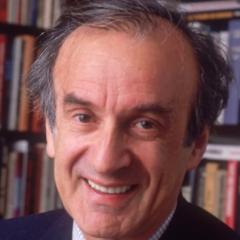
A renowned Jewish author and Nobel Peace Prize laureate, Elie Wiesel is known for his profound literary achievements and for recording and spreading the history of the Holocaust as a survivor. His works deeply reveal the terror of the Nazi Holocaust and the universal nature of human suffering. more
You May Also Like
“Nothing is more terrifying than how easily we beg for chains”
“Sometimes before your luck can be good,someone else's has to be bad”