Quotessence
Home / Quotes / Quote by Katherine Anne Porter

Quote by Katherine Anne Porter

Work

Pale Horse, Pale Rider

Browse quotes and source details for this work. more

Author
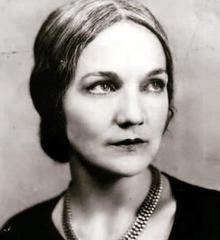
Katherine Anne Porter

American journalist, novelist, and essayist, known for her profound psychological portraits and unique narrative style. Porter, born in Texas, often explored the relationship between individuals and society, as well as themes of morality and religion in her works. Her notable works include 'The Ship of Fools' and 'The Gate of Heaven'. more

You May Also Like

“JACK: Apoplexy will do perfectly well, Lots of people die of apoplexy, quite suddenly, don't they? ALGERNON: Yes, but it's hereditary, my dear fellow. It's a sort of thing that runs in families. JACK: Good heavens! Then I certainly won't choose that. What can I say? ALGERNON: Oh! Say influenza. JACK Oh, no! that wouldn't sound probable at all. Far too many people have had it.”

“The researchers looked deeper into these observations, in hopes of gaining insight into the mechanisms underlying the high evolutionary rate and extraordinary immunologic plasticity of influenza HA. They probed in more detail the precise codons that are used by the virus to encode the influenza HA1 protein. The discriminated between codons on the basis of volatility. Each three-nucleotide codon is related by a single nucleotide change to nine 'mutational neighbours.' Of those nine mutations, some proportion change the codon to a synonymous codon and some change it to a nonsynonymous one, which directs the incorporation of a different amino acid into the protein. More volatile codons are those for which a larger proportion of those nine mutational neighbours encode an amino acid change. The use of particular codons in a gene at a frequency that is disproportionate to their random selection for encoding a chosen amino acid is termed codon bias. Such bias is common and is influenced by many factors, but here the collaborators found strong evidence for codon bias that was particular for and restricted to the amino acids making up the HA1 epitopes. Remarkably, they observed that influenza employs a disproportionate number of volatile codons in its epitope-coding sequences. There was a bias for the use of codons that had the fewest synonymous mutational neighbours. In other words, influenza HA1 appears to have optimized the speed with which it can change amino acids in its epitopes. Amino acid changes can arise from fewer mutational events. The antibody combining regions are optimized to use codons that have a greater likelihood to undergo nonsynonymous single nucleotide substitutions : they are optimized for rapid evolution.”

“I’VE BECOME MORE AWARE OF MYSELF. BECAUSE OF THE SITUATION. NOW THAT I KNOW I’M LEAVING, I SEE THINGS DIFFERENTLY. I’VE BEEN AWARE OF LITTLE THINGS THAT I WOULD HAVE MISSED BEFORE. “LIKE WHAT?” LIKE SEEING THE SUN SHINE OFF THE ROOF OF OUR OLD BARN. I SAW THAT THIS MORNING AND STOOD THERE, LOOKING AT IT. I FOUND IT MOVING. IT WAS BEAUTIFUL—IT REALLY WAS. I DON’T USUALLY THINK ABOUT IF A LANDSCAPE IS BEAUTIFUL OR NOT, BUT I COULDN’T CONTROL THIS FEELING. I SAW IT AND RECOGNIZED THAT IT WAS BEAUTIFUL. BUT YOU KNOW WHAT? IT MADE ME SAD. “SAD?” I CAN HEAR HIM TYPING. HE’S TRYING TO DO IT QUIETLY, BUT I CAN HEAR. “WHY?” I DON’T KNOW. I HAVE NO IDEA. “BECAUSE BEAUTY IS FLEETING, MAYBE?” NO, I SAY. IT’S THE OPPOSITE. BEAUTY ISN’T FLEETING. BEAUTY IS ETERNAL. BUT . . . I’M NOT. I’M FLEETING. THAT’S MORE THE POINT. HIS TYPING STOPS ABRUPTLY. “THAT’S QUITE PROFOUND. YOU DO SEEM MORE SELF-AWARE AND INTROSPECTIVE THAN WHEN I FIRST ARRIVED. IT MAKES ME THINK OF BAUdelaire: ‘I CAN BARELY CONCEIVE OF A TYPE OF BEAUTY IN WHICH THERE IS NO MELANCHOLY.’”

Book:Foe

“Three individuals were involved: the one running the experiment, the subject of the experiment (a volunteer), and a confederate pretending to be a volunteer. These three people fill three distinct roles: the Experimenter (an authoritative role), the Teacher (a role intended to obey the orders of the Experimenter), and the Learner (the recipient of stimulus from the Teacher). The subject and the actor both drew slips of paper to determine their roles, but unknown to the subject, both slips said "teacher". The actor would always claim to have drawn the slip that read "learner", thus guaranteeing that the subject would always be the "teacher". Next, the "teacher" and "learner" were taken into an adjacent room where the "learner" was strapped into what appeared to be an electric chair. The experimenter told the participants this was to ensure that the "learner" would not escape.[1] The "teacher" and "learner" were then separated into different rooms where they could communicate but not see each other. In one version of the experiment, the confederate was sure to mention to the participant that he had a heart condition.[1] At some point prior to the actual test, the "teacher" was given a sample electric shock from the electroshock generator in order to experience firsthand what the shock that the "learner" would supposedly receive during the experiment would feel like. The "teacher" was then given a list of word pairs that he was to teach the learner. The teacher began by reading the list of word pairs to the learner. The teacher would then read the first word of each pair and read four possible answers. The learner would press a button to indicate his response. If the answer was incorrect, the teacher would administer a shock to the learner, with the voltage increasing in 15-volt increments for each wrong answer. If correct, the teacher would read the next word pair.[1] The subjects believed that for each wrong answer, the learner was receiving actual shocks. In reality, there were no shocks. After the confederate was separated from the subject, the confederate set up a tape recorder integrated with the electroshock generator, which played prerecorded sounds for each shock level. After a number of voltage-level increases, the actor started to bang on the wall that separated him from the subject. After several times banging on the wall and complaining about his heart condition, all responses by the learner would cease.[1] At this point, many people indicated their desire to stop the experiment and check on the learner. Some test subjects paused at 135 volts and began to question the purpose of the experiment. Most continued after being assured that they would not be held responsible. A few subjects began to laugh nervously or exhibit other signs of extreme stress once they heard the screams of pain coming from the learner.[1] If at any time the subject indicated his desire to halt the experiment, he was given a succession of verbal prods by the experimenter, in this order:[1] Please continue. The experiment requires that you continue. It is absolutely essential that you continue. You have no other choice, you must go on.”