Quotessence
Home / Quotes / Quote by Lord Byron

Quote by Lord Byron

Work

DON JUAN

Lord Byron's Don Juan is a sprawling epic poem written in ottava rima, composed over several years until the author's death. Unlike traditional portrayals of Don Juan as a predatory seducer, Byron's protagonist is depicted as a handsome but largely unwitting figure who is seduced by others and drifts through a variety of amorous and picaresque encounters. The poem blends comedy, romance, and sharp social satire, targeting hypocrisy in politics, religion, and society. It ranges across settings from Spain to Greece, Turkey, Russia, and England, offering a panoramic view of early 19th-century European mores. The work is noted for its digressive style, witty narrator, and irreverent tone, and it remains one of the most celebrated examples of Romantic satire. more
Author

Lord Byron
Lord Byron

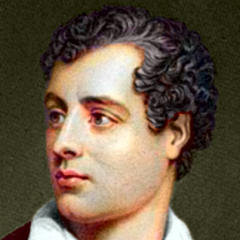
Lord Byron, born on January 22, 1788, and died on April 19, 1824, was a prominent English Romantic poet. His poetry is characterized by its strong personality and passion, and has had a profound impact on literature. more

You May Also Like

“Voices. Women's voices, like in the old ghost stories. But they weren't screaming, crying as they drowned--- they were singing. This beautiful, lilting music--- I couldn't make out the words but I remember it sounded almost like a folk song. It comforted me, made me feel safe, somehow. It was different for Danny. His whole body froze. I could smell the fear coming off him. But there was something else, too. A kind of... desire." Lucy thinks, but doesn't say, how intertwined those things are. Fear and desire. How one can become the other so easily. All it takes is the tightening of a hand on your wrist, your throat.”

“The erotic kiss is not a matter of lips only: still more are the eyes and the hands involved. And surely Sartre is right to think that, in the caress of desire I am, as he puts it, seeking to ‘incarnate the other’ – in other words, I am seeking to bring into the flesh that I touch with my hands or lips, the thing that Sartre calls freedom, and which I am calling the first person perspective. Sartre goes on to argue that sexual desire is inherently paradoxical, since it can succeed in its aim only by ‘possessing another in his freedom’ – in other words possessing another’s freedom while also removing it. I don’t agree with that. But I do think that the kiss of desire brings into prominence the very same ambiguity in the face that is present in eating. The lips offered by one lover to another are replete with subjectivity: they are the avatars of I, summoning the consciousness of another in a mutual gift. This is how the erotic kiss is portrayed by Canova, for example, in his sculpture of Eros and Psyche, and also by Rodin in ‘The Kiss’, a work that was originally called ‘Paolo and Francesca’. The lips are offered as spirit, but they respond as flesh. Pressed by the lips of the other they become sensory organs, bringing with them all the fatal entrapment of sexual pleasure, and ready to surrender to a force that breaks into the I from outside. Hence the kiss is the most important moment of desire – the moment in which soul and body are united, and in which lovers are fully face to face and also totally exposed to one another, in the manner that Francesca describes. The pleasure of the kiss is not a sensory pleasure: it is not a matter of sensations, but of the I–You intentionality and what it means. Hence there can be mistaken kisses, and mistaken pleasure in kissing, as was experienced by Lucretia, in Benjamin Britten and Ronald Duncan’s version of the story, kissing the man she thought to be her husband, and whom she discovered to be the rapist Tarquin, though too late to defend herself.”