Quotessence
Home / Quotes / Quote by John Stuart Mill

Quote by John Stuart Mill

“First, if any opinion is compelled to silence, that opinion may, for aught we can certainly know, be true. To deny this is to assume our own infallibility. Secondly, though the silenced opinion be an error, it may, and very commonly does, contain a portion of the truth; and since the general or prevailing opinion on any subject is rarely or never the whole truth, it is only by the collision of adverse opinions that the remainder of the truth has any chance of being supplied.”

Quote by John Stuart Mill

Work

On Liberty

John Stuart Mill's seminal work delves into the principles of liberty, examining the boundaries between individual rights and societal control, and advocating for the protection of personal autonomy in a democratic society. more

Author

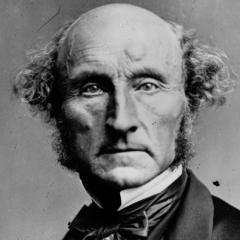
John Stuart Mill
John Stuart Mill

John Stuart Mill was an influential British philosopher, economist, and logician. He is one of the most important figures in 19th-century philosophy and his ideas had a profound impact on political, social, and philosophical thought of the time. more

You May Also Like

“Sometimes knowing is torture. You wish you could hide your secret away in a dark, cobwebby shed, shut the door, and break the key in the lock, so no one can ever get in again. You wish that you could go to sleep and have your last thought be anything but the buttery light of the New Mexico moon sneaking in through the cracks of an old barn's walls. But you can't erase the knowing, and you can never tell your secret. If there is one thing this world as taught me, it's that no matter how bad things get, they can always get worse. Secrets should stay secrets. It keeps them tolerable. Telling secrets turn them into full-on hell.”

“Young children begin very early to internalize information that either encourages or discourages self-disclosure. Cues are intuitively understood. Most of what we feel is unexamined and articulated. Cultural norms are unwittingly absorbed. We learn when to speak and when to stay silent. - Pam MacRae (Ch. 2)”

“For ten years after the atomic bomb was dropped there was so little public discussion of the bomb or of radioactivity that even the Chugoku Shinbun, the major newspaper of the city where the atomic bomb was dropped, did not have the movable type for 'atomic bomb' or 'radioactivity'. The silence continued so long because the U.S. Army Surgeons Investigation Team in the fall of 1945 had issued a mistaken statement: all people expected to die from the radiation effects of the atomic bomb had by then already died; accordingly, no further cases of physiological effects due to residual radiation would be acknowledged.”