Quotessence
Home / Quotes / Quote by Plato

Quote by Plato

“if someone got to see the Beautiful itself, absolute, pure, unmixed, not polluted by human flesh or colors or any other great nonsense of mortality, but if he could see the divine Beauty itself in its one form? Do you think it would be a poor life for a human being to look there and to behold it by that which he ought, and to be with it? Or haven't you remembered that in that life alone, when he looks at Beauty in the only way what Beauty can be seen - only then will it become possible for him to give birth no to images of virtue but to true virtue. The love of the gods belongs to anyone who has given birth to true virtue and nourished it, and if any human being could become immortal, it would be he.”

Quote by Plato

Work

The Symposium

Browse quotes and source details for this work. more

Author

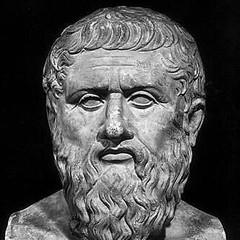
Plato
Plato

Plato (428 BC - 348 BC) was a prominent Greek philosopher, one of the most influential figures in Western philosophy. He founded the Academy, which was the first institution of higher education in the Western world. Plato's philosophy, centered around the theory of Forms, emphasized the importance of reason and morality. more

You May Also Like

“Everybody has a soul." I turn to Pelly. "And that means you, too." "I'm not so sure of that," he says. "What does it feel like?" "Having a soul?" I look at Maxine, but she only shrugs. "I don't know," I tell Pelly. "I don't have anything to compare it to- you know, what not having a sould would feel like." We fall into a kind of awkward silence. I don't know about the others, but I'm working on what a soul is and not coming up with a whole lot. I mean, I just always thought of it as me- what I feel like being me. But surely Pelly feels like himself, so that means he's got a soul right? But if that's not your soul, then what is? It's weird and not something you really think about, is it?”

“Left alone, I am overtaken by the northern void-no wind, no cloud, no track, no bird, only the crystal crescents between peaks, the ringing monuments of rock that, freed from the talons of ice and snow, thrust an implacable being into the blue. In the early light, the rock shadows on the snow are sharp; in the tension between light and dark is the power of the universe. This stillness to which all returns, this is reality, and soul and sanity have no more meaning than a gust of snow; such transience and insignificance are exalting, terrifying, all at once…Snow mountains, more than sea or sky, serve as a mirror to one’s own true being, utterly still, utterly clear, a void, an Emptiness without life or sound that carries in Itself all life, all sound.”

“Besides this I place another equally obvious confirmation of my view that opera is based on the same principles as our Alexandrian culture. Opera is the birth of the theoretical man, the critical layman, not of the artist: one of the most surprising facts in the history of all the arts. It was the demand of throughly unmusical hearers that before everything else the words must be understood, so that according to them a rebirth of music is to be expected only when some mode of singing has been discovered in which textword lords it over counterpoint like master over servant: For the words, it is argued, are as much nobler than the accompanying harmonic system as the soul is nobler than the body.”