Quotessence
Home / Quotes / Quote by Karl Marx

Quote by Karl Marx

“The history of all hitherto existing society is the history of class struggles. Freeman and slave, patrician and plebeian, lord and serf, guildmaster and journeyman, in a word, oppressor and oppressed, stood in constant opposition to one another, carried on an uninterrupted, now hidden, now open fight, that each time ended, either in the revolutionary reconstitution of society at large, or in the common ruin of the contending classes.”

Quote by Karl Marx

Work

The Communist Manifesto

Written by Karl Marx and Friedrich Engels, this influential work analyzes the historical development of capitalism and advocates for the establishment of a classless society through the proletariat's revolution. more

Author
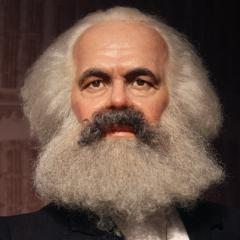
Karl Marx
Karl Marx

Karl Marx (May 5, 1818 - March 14, 1883) was a German philosopher, economist, sociologist, political theorist, and revolutionary. He is one of the founders of Marxism and his works, including 'Das Kapital' and 'The Communist Manifesto', have had a profound impact on the world. more

You May Also Like

“In 1897, Elder Joseph F. Smith... was speaking of Brigham Young's idea that Adam was the God of this world, a teaching sometimes referred to as the 'Adam-God theory.' It was something that Brigham Young taught repeatedly but that did not mesh with scriptural understandings and was eventually denounced as 'false doctrine." Joseph F. Smith explained, 'While I am not authorized to sit in judgment upon Pres[iden]t Young, I am at liberty to test the truths of his words or utterances by the revealed and accepted word of God. Anything uttered by man which is contrary to the Divine law must fall, while that only which is in harmony with it can remain, or stand.”

“In Confessions of a Justified Sinner James Hogg is neither identified with, nor overwhelmed by, the darkness of the universe, nor does he suffer from hatred or despair. He sees the cause of Wringhim's disintegration as an inner weakness which chooses to identify with false doctrine. Since Wringhim lives in illusion, he is easy meat for a master practitioner of it. Hogg himself, on the other hand, is confident of his personal wholeness. He repudiates extreme doctrine from a basis of robust common sense, and his recognition of the power of the diabolical sublime does not endanger his own sense of solid worth. He retains a forthright good-will which shows itself in cheerful endorsement of those characters in the book who accept life and enjoy themselves.”

“In taking a side, I thought uneasily, perhaps I ought to take the long view, the survival of the species as a whole. That was my problem, I thought, I was always thinking at the level of the individual, in this case the rabbit, the grim scene unfolding before me in the garden as the kite pecked at the belly of the poor beast, initiating a gyration in the corpse or almost corpse of the poor rabbit, a kind of organy wobbling. Now what was that that reminded me of? A hanging, tremulous, a doorway and a tidy garden. What happened to one’s past when one got beyond it?”