Quotessence
Home / Quotes / Quote by Joseph Campbell

Quote by Joseph Campbell

“When a judge walks into the room, and everybody stands up, you’re not standing up to that guy, you’re standing up to the robe that he’s wearing and the role that he’s going to play. What makes him worthy of that role is his integrity, as a representative of the principles of that role, and not some group of prejudices of his own. So what you’re standing up to is a mythological character. I imagine some kings and queens are the most stupid, absurd, banal people you could run into, probably interested only in horses and women, you know. But you’re not responding to them as personalities, you’re responding to them in their mythological roles. When someone becomes a judge, or President of the United States, the man is no longer that man, he’s the representative of an eternal office; he has to sacrifice his personal desires and even life possibilities to the role that he now signifies.”

Quote by Joseph Campbell

Work

The Power of Myth

This book delves into the profound influence of myths on human thought, behavior, and cultural development, offering insights into the universal themes and archetypes found in myths across different cultures and eras. more

Author
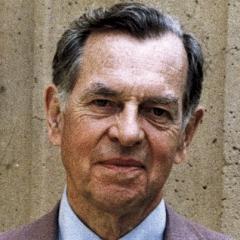
Joseph Campbell
Joseph Campbell

Joseph Campbell was an American writer, scholar, and mythologist, renowned for his studies of world mythology. His work, 'The Hero with a Thousand Faces', has had a profound impact on modern culture, widely used in literature, film, and psychology fields. more

You May Also Like

“The scent of the leather and the feel of the cold steel transported her back in time. “But Daddy, why can’t I have a sword and a scabbard? Dillon and Tynan have one and look, I can lift it above my head, too.” Kylah chuckled because she hadn’t lifted it above her head; she’d barely lifted the broadsword off the floor. But Cearnach was always supportive. He’d told her, “Someday, little one… someday you will be a great warrior just like your brothers.”

“Kylah grabbed a handful of grapes off the tray and started tossing them at Aerric. He tried to catch them in his mouth but was missing more than he was catching. “You totally suck at this,” she said as she laughed. In a flash, Aerric pinned her beneath him. “But I’m fantastic at other things,” he said as he pushed the robe off her shoulder.”

“The child's world is alert and alive, governed by rules of response and command, not by physical laws: a portentous continuum of consciousness, endowed with purpose and intent, either resistant or responsive to the child itself. This infantile notion of a world governed by moral rather than physical laws, kept under control by a superordinated parental personality instead of impersonal physical forces, and oriented to the weal and woe of man, is an illusion that dominates men's thoughts all over the world. The sense then, of this world as an undifferentiated continuum of simultaneously subjective and objective experience (Participation), which is all alive (Animism), and which was created by a superior being (Artificialism), may be said to constitute the frame of reference of all childhood experience no matter where in the world. No small wonder then, that the above Three Principles are precisely those most represented in the mythologies and religious systems of the whole world.”

“There were formerly horizons within which people lived and thought and mythologized. There are now no more horizons. And with the dissolution of horizons we have experienced and are experiencing collisions, terrific collisions, not only of peoples but also of their mythologies. It is as when dividing panels are withdrawn from between chambers of very hot and very cold airs: there is a rush of these forces together. And so we are right now in an extremely perilous age of thunder, lightning, and hurricanes all around. I think it is improper to become hysterical about it, projecting hatred and blame. It is an inevitable, altogether natural thing that when energies that have never met before come into collision—each bearing its own pride—there should be turbulence. That is just what we are experiencing; and we are riding it: riding it to a new age, a new birth, a totally new condition of mankind—to which no one anywhere alive today can say that he has the key, the answer, the prophecy, to its dawn. Nor is there anyone to condemn here (”Judge not, that you may not be judged!”). What is occurring is completely natural, as are its pains, confusions, and mistakes.”