Quotessence
Home / Authors / Joseph Campbell Biography
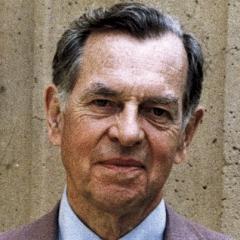
Joseph Campbell

Joseph Campbell Biography

Writer

Related Quotes

“Nietzsche was the one who did the job for me. At a certain moment in his life,the idea came to him of what he called 'the love of your fate.' Whatever your fate is, whatever the hell happens, you say, 'This is what I need.' It may look like a wreck, but go at it as though it were an opportunity, a challenge. If you bring love to that moment--not discouragement--you will find the strength is there. Any disaster you can survive is an improvement in your character, your stature, and your life. What a privilege! This is when the spontaneity of your own nature will have a chance to flow. Then, when looking back at your life, you will see that the moments which seemed to be great failures followed by wreckage were the incidents that shaped the life you have now. You’ll see that this is really true. Nothing can happen to you that is not positive. Even though it looks and feels at the moment like a negative crisis, it is not. The crisis throws you back, and when you are required to exhibit strength, it comes.”

“The image that comes to mind is a boxing ring. There are times when...you just want that bell to ring, but you're the one who's losing. The one who's winning doesn't have that feeling. Do you have the energy and strength to face life? Life can ask more of you than you are willing to give. And then you say, 'Life is not something that should have been. I'm not going to play the game. I'm going to meditate. I'm going to call "out".' There are three positions possible. One is the up-to-it, and facing the game and playing through. The second is saying, Absolutely not. I don't want to stay in this dogfight. That's the absolute out. The third position is the one that says, This is mixed of good and evil. I'm on the side of the good. I accept the world with corrections. And may [the world] be the way I like it. And it's good for me and my friends. There are only the three positions.”

“The first and foremost aim of Zen, consequently, is to break the net of our concepts -which is why it has been termed by some a philosophy of "no mind." A number of schools of Occidental psychological therapy hold that what we all most need an are seeking is a meaning for our lives. For some, this may be a help; but all it helps is the intellect, and when the intellect sets to work on life with its names and categories, recongnitions of relationship and definitions of meaning, what is inwardmost is readily lost. Zen, on the contrary, holds the realization that life and the sense of life are antecent to meaning; the idea being to let life come and not name it. It will then push you right back to where you live- where you are, and not where you named.”

“Though omnipotence may seem to be endangered by the threshold passages and life awakenings, protective power is always and ever present within the sanctuary of the heart and even immanent within, or just behind, the unfamiliar features of the world. One has only to know and trust, and the ageless guardians will appear. Having responded to his own call, and continuing to follow courageously as the consequences unfold, the hero finds all the forces of the unconscious at his side.”

“Jung’s image of the stage of becoming a tree is well illustrated here. The little man is stuck. In the West he would be taken away, perhaps, to an institution and cured back (shock treatment, etc.) to society. Here, he is permitted to sit it out and perhaps go through to Buddhahood—perhaps, on the other hand, simply to remain stuck, as a living symbol of spiritual effort. There are no hospitals, there are no asylums. The lepers sit out on the streets and so do the madmen. But some of the madmen can break through, and these breakthroughs are giving India something that the West really lacks.”

“For the human mind in its polarity of the male and female modes of experience, in its passages from infancy to adulthood and old age, in its toughness and tenderness, and in its continuing dialogue with the world, is the ultimate mythogenetic zone -the creator and destroyer, the slave and yet the master, of all the gods.”

“When the Buddha declares there is escape from sorrow, the escape is Nirvana, which is not a place, like heaven, but a psychological state of mind in which you are are released from desire and fear. And your life becomes harmonious, centered and affirmative. Even with suffering. The Buddhists speak of the bodhisattva - the one who knows immortality, yet voluntarily enters into the field of the fragmentation of time and participates willingly and joyfully in the sorrows of the world.”

“A ritual is the enactment of a myth. And, by participating in the ritual, you are participating in the myth. And since myth is a projection of the depth wisdom of the psyche, by participating in a ritual, participating in the myth, you are being, as it were, put in accord with that wisdom, which is the wisdom that is inherent within you anyhow. Your consciousness is being re-minded of the wisdom of your own life. I think ritual is terribly important.”

“The battlefield is symbolic of the field of life, where every creature lives on the death of another. A realization of the inevitable guilt of life may so sicken the heart, that like Hamlet, or like Arjuna, one may refuse to go on with it. On the other hand, like most of the rest of us, one may invent a false finally unjustified image of oneself as an exceptional phenomenon in the world--not guilty as others are, but justified in one's inevitable sinning, because one represents the good. Such self-righteousness leads to a misunderstanding, not only of oneself, but of the nature of both Man and the Cosmos. The goal of the myth is to dispel the need for such life-ignorance by affecting a reconciliation of the individual consciousness with the universal will, and this is affected through a realization of the true relationship of the passing phenomena of time to the imperishable life that lives and dies in all.”

“When we look back at that text [the Bible], it is a text that speaks of man as superior to nature, man’s mastery over nature as being what was given to him. Compare that with the words of Chief Seattle. This is the difference between mythology as a petrifact, something that has dried up, is dead, and is not working, and mythology as something that is working. When the mythology is alive, you don’t have to tell anybody what it means. It’s like looking at a picture that’s really talking to you. It gets to you.”