Quotessence
Home / Quotes / Quote by Charles Dickens

Quote by Charles Dickens

“My sister's bringing up had made me sensitive. In the little world in which children have their existence whosoever brings them up, there is nothing so finely perceived and so finely felt, as injustice. It may be only small injustice that the child can be exposed to; but the child is small, and its world is small, and its rocking-horse stands as many hands high, according to scale, as a big-boned Irish hunter. Within myself, I had sustained, from my babyhood, a perpetual conflict with injustice. I had known, from the time when I could speak, that my sister, in her capricious and violent coercion, was unjust to me. I had cherished a profound conviction that her bringing me up by hand, gave her no right to bring me up by jerks. Through all my punishments, disgraces, fasts and vigils, and other penitential performances, I had nursed this assurance; and to my communing so much with it, in a solitary and unprotected way, I in great part refer the fact that I was morally timid and very sensitive.”

Quote by Charles Dickens

Work

Great Expectations

This novel follows the journey of Pip, a young boy who is raised by his sister and her husband, Joe Gargery, a blacksmith. After receiving a mysterious gift that leads him to believe he has been chosen for a better life, Pip embarks on a quest to fulfill his 'great expectations.' The story delves into Pip's interactions with various characters, including the wealthy Miss Havisham and her adopted daughter Estella, and the convict Magwitch, who ultimately reveals a profound connection to Pip's past. more

Author
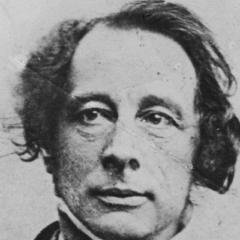
Charles Dickens
Charles Dickens

Charles Dickens, a British writer born on February 7, 1812, and died on June 9, 1870, is one of the greatest novelists of the 19th century. Known for his profound social criticism and vivid narrative style, Dickens' works extensively cover social reality, revealing various issues in the British society of the time. more

You May Also Like

“Are you what is called a lucky man? Well, you are sad every day. Each day has its great grief or its little care. Yesterday you were trembling for the health of one who is dear to you, today you fear for your own; tomorrow it will be an anxiety about money, the next day the slanders of a calumniator, the day after the misfortune of a friend; then the weather, then something broken or lost, then a pleasure for which you are reproached by your conscience or your vertebral column; another time, the course of public affairs. Not to mention heartaches. And so on. One cloud is dissipated, another gathers. Hardly one day in a hundred of unbroken joy and sunshine. And you are of that small number who are lucky! As for other men, stagnant night is upon them.”

“They were happier now than they would ever be again. A tenpenny tea set made Cam happy for days. She heard them stamping and crowing on the floor above her head the moment they woke. They came bustling along the passage. Then the door sprang open and in they came, fresh as roses, staring, wide awake, as if this coming into the dining-room after was a positive event to them, and so on, with one thing after another, all day long, until she went up to say good-night to them, and found them netted in their cots like birds among cherries and raspberries, still making up stories about some little bit of rubbish-–something they heard, something they had picked up in the garden. They had all their little treasures. . . And so she went down and said to her husband, Why must they grow up and lose it all? Never will they be so happy again. And he was angry. Why take such a gloomy view of life? he said. It is not sensible. For it was odd; and he believed it to be true; that with all his gloom and desperation he was happier, more hopeful on the whole, than she was. Less exposed to human worries––perhaps that was it. He had always his work to fall back on.”

“...and hidden somewhere inside every bluff or quiet man and woman I know ... is the fully formed, but uncompleted, little boy or girl that once was and will always remain as it always has been, suspended lonesomely inside its own past, waiting hopefully, vainly, to resume, longing insatiably for company, pining desolately for that time to come when it will be safe and sane and possible to burst outside exuberantly, stretch its arms, fill its lungs with invigorating air, without fear at last, and call: "Hey! Here I am. Couldn't you find me? Can't we be together now?”

“She'd loved birds long before her physical limitations kept her grounded. She'd found a birding diary of her grandmother's in a trunk in the attic when she was Frankie's age, and when she asked her father about it, he dug through boxes on a shelf high above her head, handing down a small pair of binoculars and some field guides. She'd seen her first prothonotary warbler when she was nine, sitting alone on a tupelo stump in the forest, swatting at mosquitoes targeting the pale skin behind her ears. She glanced up from the book she was reading only to be startled by an unexpected flash of yellow. Holding her breath, she fished for the journal she kept in her pocket, focusing on the spot in the willow where he might be. A breeze stirred the branches, and she saw the brilliant yellow head and underparts standing out like petals of a sunflower against the backdrop of leaves; the under tail, a stark white. His beak was long, pointed and black; his shoulders a mossy green, a blend of the citron yellow of his head and the flat slate of his feathers. He had a black dot of an eye, a bead of jet set in a field of sun. Never had there been anything so perfect. When she blinked he disappeared, the only evidence of his presence a gentle sway of the branch. It was a sort of magic, unveiled to her. He had been hers, even if only for a few seconds. With a stub of pencil- 'always a pencil,' her grandmother had written. 'You can write with a pencil even in the rain'- she noted the date and time, the place and the weather. She made a rough sketch, using shorthand for her notes about the bird's coloring, then raced back to the house, raspberry canes and brambles speckling bloody trails across her legs. In the field guide in the top drawer of her desk, she found him again: prothonotary warbler, 'prothonotary' for the clerks in the Roman Catholic Church who wore robes of a bright yellow. It made absolute sense to her that something so beautiful would be associated with God. After that she spent countless days tromping through the woods, toting the drab knapsack filled with packages of partially crushed saltines, the bottles of juice, the bruised apples and half-melted candy bars, her miniature binoculars slung across one shoulder. She taught herself how to be patient, how to master the boredom that often accompanied careful observation. She taught herself how to look for what didn't want to be seen.”